Making the machine talk
The vocoder is audio's oldest identity theft: take the shape of one sound
and wear it over the body of another. Speech works because your mouth
sculpts a moving spectral envelope; a vocoder measures that envelope on one
signal (the modulator — usually a voice) and stamps it onto another (the
carrier — usually a synth), and the synth talks. tap.vocoder~ is the
classic architecture: a 24-band channel vocoder, time-domain, no FFT. This
chapter is how to wire it and — mostly — how to choose the two signals, which
is nine tenths of vocoding.
Companion material: the reference page and help patcher in the TapTools-Max package; the kernel's Catch suite pins the structural behavior quoted below.
The machine, in one pass
Two identical banks of 24 bandpass filters, log-spaced from 50 Hz to 12 kHz (RBJ constant-peak biquads — unconditionally stable across the range). The modulator goes through one bank; a per-band envelope follower measures each band's level. The carrier goes through the other bank; each carrier band is multiplied by the matching modulator envelope; the bands are summed. That's the whole machine — which is why its behavior is so predictable:
- A silent carrier is silence, no matter what the modulator does (pinned by test): the modulator only ever gates; every sample you hear is carrier.
- Gain is exactly linear (pinned): the vocoder adds no nonlinearity of its own.
- A silent modulator decays to silence at the follower rate — the vocoder "lets go" of the carrier the way the voice lets go of a word.
The wiring
Modulator in the left inlet, carrier in the right. Getting these backwards is the classic first-patch bug, and it sounds like it: a synth "speaking" your voice is right; your voice weakly filtered by a synth is backwards.
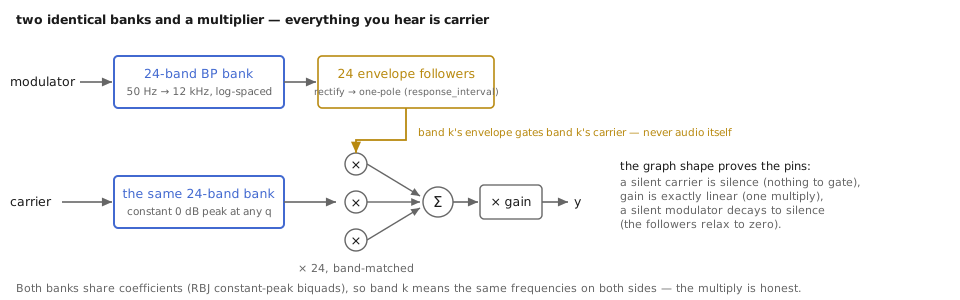
Two identical banks meeting at 24 multipliers. Envelopes gate the carrier; modulator audio never reaches the output.
The knobs, one by one
q — intelligibility vs. smoothness
The bandwidth of all 48 filters. Narrow (high q) separates the bands cleanly — crisper consonant detail, more "robot" — but thins the carrier between band centers. Wide (low q) overlaps the bands into a smoother, duller blend. The classic hardware vocoders sat toward smooth; intelligibility came from performance, not q.
response_interval — how fast the mouth moves
The envelope followers' period in ms. Short tracks every consonant — crisp, maximally intelligible, and a little nervous. Long smears syllables into pads — the "choir" setting. This knob is the vocoder's attack and release; 20–50 ms speaks, 200+ ms sings.
gain
Makeup level, since a band-multiplied signal usually lands quieter than either input. Linear, boring, necessary.
sibilance — the built-in s and t budget
The classic channel-vocoder unvoiced path (Dudley's lineage): a seeded
internal noise source blended into the carrier of the bands above
~4 kHz, still gated by the modulator's envelopes — so consonants articulate
even over a dull carrier, and only when the modulator actually has
high-band energy (pinned: a silent carrier with an HF-rich modulator
speaks at sibilance 1; a low-only modulator stays quiet). At the default
0 the original silent-carrier contract holds exactly, bit-identical —
turning it up deliberately relaxes that contract for the top bands. The
noise is deterministic per seed, family doctrine.
mix — the synth under its own robot voice
Equal-power blend of the dry carrier against the vocoded output — the classic parallel move (the pad fades in under itself talking). Endpoints are exact: 100 is bit-identical wet, 0 returns the carrier untouched.
Choosing the two signals (the actual craft)
- The carrier must have energy where the modulator has bands. The eternal
vocoder failure is a dull carrier: a mellow sine pad gives the high bands
nothing to gate, and consonants vanish. The house answer is upstairs in
this book — a
tap.vco~saw stack (harmonics forever, and the analog section keeps it moving) is a nearly ideal carrier; noise (tap.noise~) blended in restores the s and t sounds that even a saw can't carry. - The modulator wants articulation, not fidelity. Overdriven, compressed, even cheap-microphone speech vocodes better — what matters is envelope contrast between bands, not beauty.
- Nobody said voice. Drums modulating a pad turns the pad into rhythm; a cello modulating noise is a ghost. The machine imposes any moving envelope on any body.
Recipes
- The talking synth: speech → left;
tap.vco~saw stack + 10 % noise → right;response_interval 30,qmiddling, and enunciate like you're annoyed. - The choir: sustained "aah"s → left; detuned saws → right;
response_interval 250. Consonants don't matter; vowels are the chord. - Rhythm transfer: a drum loop → left; anything sustained → right; short
response_interval. The drums play the pad.
When it is not the right tool
- Pitch correction or transposition — a channel vocoder never changes the
carrier's pitch; it only shades its bands. Pitch is
tap.shift~/tap.pitchaccum~territory. - High-fidelity cross-synthesis. Twenty-four bands is a voice, not a
spectrograph; for surgical spectral morphing you want FFT-domain tools
(
tap.spectra~is the start of that corridor). - Formant preservation while shifting — related, but a different machine:
tap.harmony~, which multiplies the voice itself instead of wearing it over a carrier.
Checkpoint
Two matched 24-band banks, 50 Hz–12 kHz: the modulator's per-band envelopes
gate the carrier's bands, and everything you hear is carrier. q trades
crispness against smoothness, response_interval is the mouth's speed, and
the craft is almost entirely in feeding it a bright, busy carrier and an
articulate modulator. The machine is simple; the casting is everything.