Five strings, no guitar
Feed a comb filter its own output and it stops being an EQ curiosity and
becomes a string: a resonator with a pitch, a ring time, and a temperament.
Five of them, tuned by hand, is an instrument — that was the insight of the
GRM Tools Classic "Comb Filters" plugin, and tap.5comb~ is its recreation:
five resonant combs with per-voice tuning, masters that play the whole bank,
and the preset-morph engine that made the GRM tools feel alive. This chapter
is how to tune, ring, and morph it.
Companion material: the reference page and help patcher in the TapTools-Max
package, and the grm_comb_render tool in the kernel repo, which renders the
listening-check scenarios outside Max.
What a resonant comb actually is
A delay of 1/f seconds fed back on itself resonates at f and all its harmonics — pluck it with noise and it rings like a string tuned to f. Two implementation details decide whether five of them sound like a chorus of strings or like a broken flanger, and both were the reasons this object was recreated rather than ported:
- Fractional delays. At 48 kHz, a 440 Hz comb needs a delay of 109.09 samples. Round it to 109 and the comb plays 440.37 Hz — every voice lands on a slightly wrong, slightly different wrong pitch, and the beating between voices (the whole point of a bank) is gone. The delays here are Hermite-interpolated: the tuning is continuous, and sweeps glide instead of zippering.
- No clipper in the loop. The feedback path uses a DC blocker and a precise feedback cap, not a hard limiter — high resonance rings clean instead of distorting.
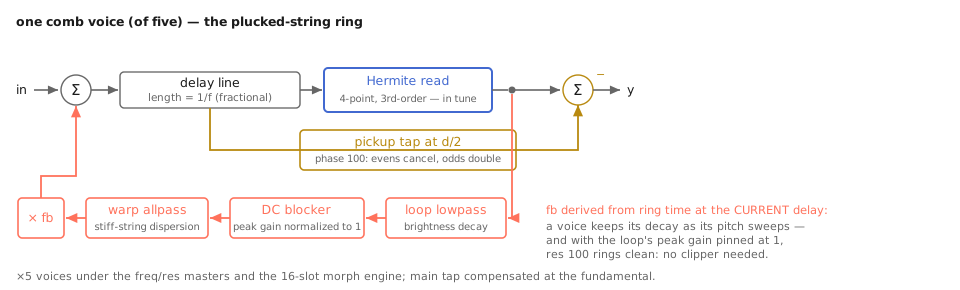
One voice of five. The red ring is the string; the amber tap is the pluck position.
The knobs, one by one
freq1..5 and freq — the tuning
Per-voice frequencies (5 Hz floor, the GRM's own) — or the notes
message, which tunes up to five combs from MIDI note numbers in one list
(fractional allowed) — plus a master multiplier
(0..2) that transposes the whole bank — the master is the performance
control, gliding every voice proportionally so chords stay chords.
res1..5 and res — ring time, not feedback
Resonance is mapped to ring time on a log curve, 20 ms to 100 s, and the feedback coefficient is derived from the current delay — so a voice keeps its ring time as its pitch sweeps, instead of ringing longer at low notes and choking at high ones (the raw-feedback behavior of naive combs, and of the legacy abstraction). 50 is a decaying pluck; 80+ sustains; near 100 it is a drone that outlives your patience.
lp1..5 and lp — the string's brightness
A one-pole lowpass inside each feedback loop: every pass around the loop gets darker, which is exactly how real strings decay (highs first). Open it for metallic; close it toward a few hundred Hz for felt and thump.
warp — stiff strings
New to this recreation: a negative-coefficient allpass in the loop disperses the partials — upper harmonics round-trip faster and stretch sharp, the inharmonicity of a stiff piano string. The main tap is compensated at each voice's fundamental, so the pitch stays put while the timbre goes piano-ish, then bell-ish. At extreme warp × high tuning the loop can't get shorter than the dispersion and the pitch flattens — physical, and documented.
phase — where you pluck the string
Also new: a half-loop pickup tap. At 100 the even harmonics cancel — the sound of plucking a string exactly at its midpoint. Neutral at 0.
gain, mix, and the morph engine
Equal-power dry/wet and output gain, plus the GRM hallmark: sixteen preset
slots with timed interpolation. store 1, retune everything, store 2,
then recall 1 8000 — every frequency, resonance, and damping glides for
eight seconds through territory you never explicitly tuned. Grabbing one
parameter mid-morph overrides just that parameter. The morph is not a
transition between sounds; it is the sound.
Recipes
- The resonator chord: tune
freq1..5to a voicing (say 80/120/160/200/ 102 Hz — the legacy factory preset),reshigh, and feed it drums or speech. The input is now an excitation signal for your chord. - The piano that isn't: moderate resonance,
warp 40,lparound 3 kHz, and pluck with clicks. - The eight-second gesture: two stored extremes and a long
recall— the classic GRM move. Automate nothing else.
When it is not the right tool
- One comb, precise and plain:
tap.comb~is the single, cheaper unit. - Echoes rather than pitch: delays long enough to hear as repeats are
tap.delay~/tap.multitap~territory — a comb is a delay, but this one is tuned and normalized for resonance, not slapback. - Faithful nostalgia: this deliberately is not the legacy
tap.5comb~abstraction — the integer delays, linear feedback, and in-loop clipper it had are exactly what was retired, and the deviations are flagged in the reference page for the audition.
Checkpoint
Five Hermite-tuned resonant combs with ring time on a log map (20 ms–100 s),
per-loop damping, and two ways to bend the string physics (warp for
stiffness, phase for pluck position) — under masters that transpose the
bank and a sixteen-slot morph engine that turns retuning into performance.
Strings, chords, drones, and gestures; no guitar required.