Loops that never line up
Take seven tape loops of deliberately awkward lengths — none a multiple of
another — put one soft phrase on each, and let them all turn at once. Each
loop is trivial: it plays the same thing forever. The system is not: the
phrases drift against each other, meet, part, and meet again differently,
and the pattern of coincidences does not repeat within a human afternoon.
That is "2/1" from Brian Eno's Music for Airports (Ambient 1, EG, 1978),
as he described the rig in the album's liner notes and in A Year with
Swollen Appendices: the lengths are the score, and the machine's whole job
is to keep the loops turning without an opinion. tap.airport~ is that
machine — up to eight free-running loops, each with a single head that both
plays and records, summed to stereo.
The discipline that makes it the instrument it is: nothing resets a phase. Not recording, not a level move, not a pan, not even a length change. The free-run is the composition, and the kernel treats the heads as sacred; the test suite literally hammers every setter mid-run and then checks that the heads have advanced by exactly the samples processed.
Companion material: the executed notebook airport.ipynb, which measured
every claim below, and the eno_render tool's airport_two_one scenario —
three stereo minutes of seven loops, the listening copy. The Max wrapper
lands in the TapTools-Max package alongside the rest of the family.
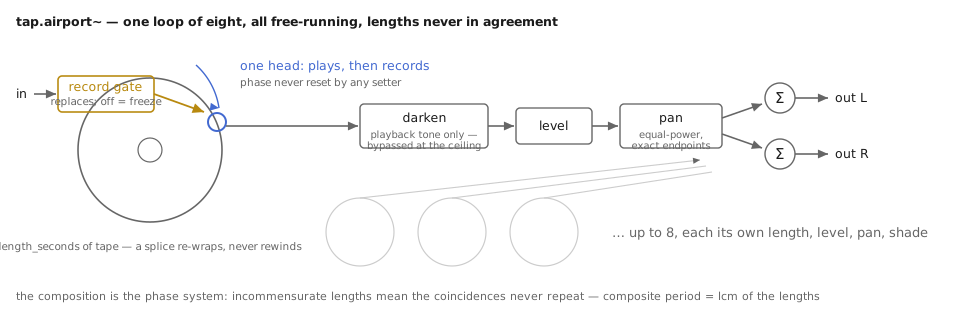
One loop of eight. The head plays, then records, then advances; nobody ever tells it where to be.
Record and return
record(loop, 1) punches the input onto that loop's tape at wherever its
head happens to be — there is no downbeat, no quantized punch-in, because
Eno's rig had none. Recording replaces (each phrase was recorded once, not
overdubbed), and playback reads just ahead of the write, so while recording
you hear the previous generation under the head. record(loop, 0) freezes
the tape, and freezes it bit-exactly: the pinned test compares two whole
passes of a frozen loop and requires them identical to the bit. A loop is
not a degrading medium here — it replays the same magnetic imprint every
revolution, which is why this kernel deliberately has no per-pass
generation loss (that is tap.discreet~'s physics, not a loop's).
The lengths are the score
length_seconds per loop is where the composing happens. Two loops of
24000 and 30000 samples realign only at their least common multiple —
120000 samples, 2.5 seconds — and the kernel will tell you:
composite_period_seconds reports exactly 2.5 for that pair, confirmed in
the notebook by rendering the coincidence raster and watching it repeat at
2.5 s and at no shorter lag.
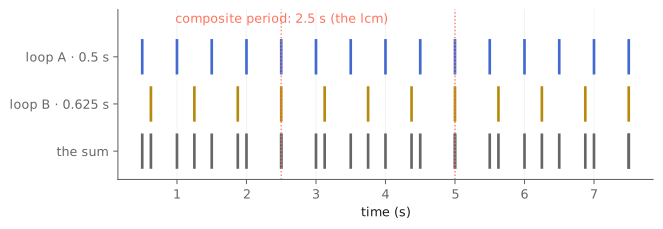
Two awkward lengths and their coincidences. Stretch the lengths and the composite period leaves the room.
Then stretch toward the piece: give seven loops airport-scale lengths in awkward ratios and the composite period overflows a 64-bit sample count — the kernel reports infinity, which is not a failure mode. It is the point.
Changing a length while running is a splice: the tape keeps its content and the head re-wraps modulo the new length — never rewinding — exactly as cutting a physical loop shorter would land you mid-phrase. It can click. Splices do.
Level, pan, shade
Each loop has a slewed linear level, an equal-power pan with exact
endpoints (a hard-panned loop is bitwise absent from the far bus — the
same law as tap.multitap~), and a darken corner that shades that loop's
playback tone. The shade is a static one-pole per loop, not wear: measured
in the notebook, a 6 kHz phrase through a 1 kHz shade lands at 0.169 of its
transparent twin, against an analytic prediction of 0.169. At the band
ceiling — the default — the shade stage is bypassed entirely and playback
is bit-transparent, which is what makes the freeze and hard-pan promises
testable as bitwise facts rather than tolerances.
There is deliberately no wow here: the phasing engine of "2/1" is the
incommensurate lengths, not pitch drift. If a loop's source should breathe
like tape, run it through tap.discreet~ on the way in.
Recipes
- The terminal: seven loops,
@lengths 17.8 19.1 21.3 23.9 26.2 28.7 30.9, one sustained tone phrase recorded onto each, levels around 0.45, pans spread wide, a 4 kHz shade on two of them. Let it run. Come back in an hour; it will not have repeated. - Phase study: two loops, lengths in a near ratio (say 8.0 and 8.1), the same short phrase on both, panned hard left and right — the Reich-adjacent version, where the drift itself is the melody.
- Sound-on-sound sketchpad: one loop,
@lengths 12., record gate on a footswitch. Punch in fragments as they occur to you; the head's indifference to your downbeat is the charm. - Breathing loops: patch sources through
tap.discreet~(gentle wow, regen 0) before the record gate — tape transport on the way in, stable free-run once captured.
The same machine, in pieces
There was never a loop bank doing loop-bank things in here — there is an
array of eight identical lanes and a summing loop. That lane is now an
object of its own, tap.reel~, and three of them summed are a
tap.airport~ bitwise (pinned in tests/airport_test.cpp). Patch it
instead of using this object when you want an insert on one loop, a
varispeed on one reel, more than eight loops, or tape you actually use —
the bank buys all eight worst-case reels at DSP start regardless. See
The same machine, in pieces.
When it is not the right tool
- Synchronized looping. This machine never lines up by design. A beat-locked looper wants a phase reset on the downbeat, which is the one thing this kernel refuses to do.
- Degrading loops. A frozen loop here is bit-eternal. For material that
should wear out as it circulates,
tap.discreet~is the machine with the forgetting built in. - Dense delay textures. Eight long loops is a composition system, not
an echo;
tap.multitap~does a hundred taps without ceremony.
Checkpoint
Up to eight free-running loops, one sacred head each: record replaces at
wherever the head is, freeze is bitwise, splices re-wrap and never rewind,
and no setter touches a phase. Level, exact-endpoint pan, and a bypassable
playback shade place the phrases; the lengths do the composing, and
composite_period_seconds tells you how long until the piece repeats —
ideally, longer than you will be alive. Every number above lives twice: as
an executed cell in airport.ipynb and as a pinned scenario in
tests/airport_test.cpp, which CI runs on every push.