Two hands on the same tape
tap.stammer~ and tap.scrub~ record the same way. Both keep a rolling
tape of what just went past — the same capture, literally the same code,
not a second copy of it — and both put a read pattern on top of it. The
stutter's pattern is a slicer with dice. The scrub's is a pad you drag.
That is the whole difference, and it is the difference between a machine that decides and a machine you play. The stammer is a die you load; the scrub is a surface you push around, in the Kaoss-pad school of instruments where an XY surface over live capture is the entire interface. It belongs in this part of the book for the same reason the tape echo does: nobody sets this object up and walks away from it.
It is an original design in the granular / brassage tradition (Roads, Microsound, MIT Press 2001) — not a port, and not a reconstruction of any product. No preset, timing or parameter value in it came from a piece of hardware.
Companion material: the executed notebook scrub.ipynb, the pinned
scenarios in tests/scrub_test.cpp, and the radiohead_render scenes
scrub_gesture and scrub_freeze.
The two axes are actually two axes
position is how far back the playhead sits, as a lag in milliseconds
behind the live edge. pitch is transposition in semitones. On tape those
would be the same knob — moving the head is the pitch change — and the
whole point of doing this with grains is that here they are not. Hold the
position and sweep the pitch and the material transposes without going
anywhere. Sweep the position at a fixed pitch and you rake through the last
few seconds without the tape rising or falling.
drift is the third one, and it is the playhead's own motion through the
tape in playback-rate units: 1. runs forward at the speed the recorder is
writing, 0. holds station, negative runs backwards. Set @drift 1. and
let go of the position and the scrub is a delay; set @drift 0. and it is a
freeze that you can still transpose.
The identity underneath it
Grains are Hann-windowed and fired every size / overlap samples. Hann
overlap-adds to exactly 1 at that hop, so with the pitch at unity, spray
at zero and the position held on a whole sample, the scrub is the input,
delayed, to floating point — 4.4e-16 in the pinned test.
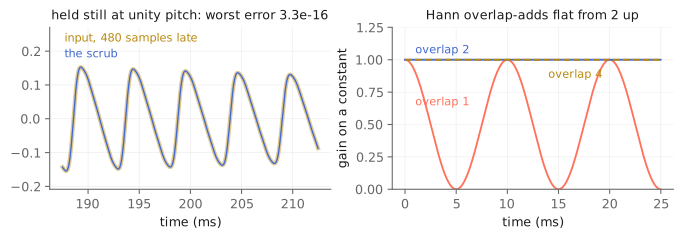
Left: held still at unity, the object is a delay and nothing else. Right: the window sum that makes it one.
This matters more than it sounds. Everything else the object does is a departure from a plain delay, and a departure is only trustworthy if you know the thing it departs from is exact. When the position drags, when the pitch moves, when spray scatters the origins — those are the object working. If the still case were approximate, you could not tell them apart from noise.
overlap 1 leaves gaps between grains, which is the dipping curve in that
figure. That is a chopped, gated texture rather than a defect, and it is
worth having; it is just not the setting the null lives at.
What transposing costs, honestly
Reading tape at a rate the write head does not share means the read pointer drifts away from where the position says it is, and it has to be pulled back or the position stops meaning anything. Every pull-back is a splice between two grains reading material a little apart.
What that costs is not the pitch. Swept over seven fundamentals and seven intervals, 98.8 % of a perfect shifter's energy lands within ±15 Hz of the transposed pitch — worst case 91.7 %. The note is where you asked for it.
What it costs is concentration. The band holds a narrow comb rather than one clean line: 92.0 % as concentrated as a clean shift, 75.0 % at its worst.
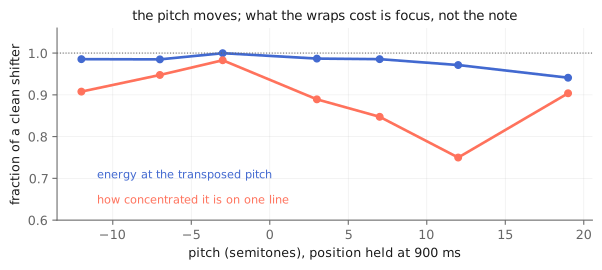
The pitch goes where you put it. What the splices take is focus.
Audibly that is a warble, and it is the classic single-delay-line
pitch-shifting artifact rather than anything peculiar to this kernel. If you
want the warble gone, spray trades the comb for a broadband smear, which
some material prefers. If you want a clean shift, this is the wrong object —
see below.
freeze, and what it does not stop
freeze stops the recorder. The playhead keeps going, so the position now
addresses fixed tape and the grains loop the same window: a granular hold
you can still scrub, transpose and drift through. It does not stop time
inside a grain — a grain in flight when freeze engages was already
scheduled, and it finishes.
spray and seed
spray scatters each grain's origin randomly back from the position. At
exactly 0 the dice are never rolled, so the seed provably cannot matter —
the same contract tap.garden~ and tap.stammer~ carry, pinned by the same
kind of test. With spray up, the same seed and the same moves give the same
render bit for bit, and two instances decorrelate by seed alone.
Recipes
- The pad:
@drift 0. @size 80 @overlap 2 @mix 100, then ridepositionwith a signal. The default instrument. - Granular freeze:
@freeze 1 @drift 0. @size 120 @spray 40. Hold, then movepitchfor a chord that was never played. - Backwards tape:
@drift -1. @pitch 0.— the playhead walking against the recorder. - Chopped:
@overlap 1 @size 40. Gaps between grains, on purpose. - Into the diffuseur:
tap.scrub~→tap.palme~with the palme's@mixaround 40. The strings sustain what the scrub chops.
When it is not the right tool
- Clean transposition. The warble above is inherent to the method.
tap.shift~andtap.pitchaccum~are the objects built for that job — with one caveat worth stating plainly: measured on this same sweep,tap.pitchaccum~retained mean 0.907 of band energy against the scrub's 0.988, worst 0.633 against 0.917. Its two-tap crossfade also puts its strongest spectral line a few hertz beside the intended pitch, which is filed as issue #33. None of that makes it the wrong object — it is a shimmer, and shimmer is what those sidebands are — but audition before you assume it is the transparent one. - A tidy delay.
tap.delay~andtap.tapecho~cost far less and do not window anything. - Slicing to a grid. That is
tap.stammer~, on the same tape.
Checkpoint
One tape shared with the stutter, one grain scheduler on top of it, and two
axes that stay independent because grains let them. The still case is a
bit-exact delay, which is what makes every departure from it legible.
Transposing warbles, and the warble is measured rather than apologized for:
the note holds to 98.8 % of a clean shifter's energy, and 92.0 % of its
focus. Every number here lives twice, as a cell in scrub.ipynb and as a
pinned scenario in tests/scrub_test.cpp.