Ring time as the truth: grm_comb.h
The user-facing chapter made three claims that sound like
marketing until you do the math: that a voice keeps its decay as its pitch
sweeps, that warp stretches the partials while the fundamental stays in
tune, and that phase at 100 cancels the even harmonics — exactly. This
appendix derives all three the way the file was designed, then walks the
code-level decisions. The behavioral claims below are pinned by the kernel
scenarios in tap.5comb_tilde_test.cpp, which drive
tap::tools::fivecomb::comb_bank directly (no Max in the loop); the few
numbers outside the test suite are marked as measured on the kernel for
this chapter.
A comb is a string
One voice is a delay of d samples fed back on itself. Ignoring the in-loop
filters for a moment, the recursion the code implements
(y = in + fb * ap_out, written back into the delay line) is:
y[n] = x[n] + fb · y[n − d] h[n] = δ[n] + fb·δ[n−d] + fb²·δ[n−2d] + …
The impulse response is echoes every d samples, each scaled by another factor of fb — and echoes every 1/f seconds is a tone at f and its harmonics: a plucked string tuned to f = fs/d. The first kernel scenario pins the geometry: a 500 Hz voice at 48 kHz (d ≈ 96) puts its first three echoes at one period spacing, within a couple of samples of 96/192/288.
Ring time as the truth
The legacy object exposed fb directly. This file refuses to, and the reason
is in the impulse response above. After t seconds the signal has made t·fs/d
round trips, so the decay envelope is level(t) = fb^(t·fs/d).
Reverberation's standard yardstick is RT60, the time to fall 60 dB — a factor of 10^(−60/20) = 10⁻³. Set level(rt60) = 10⁻³ and solve:
fb^(rt60 · fs / d) = 10⁻³ ⇒ fb = 10^(−3·d / (rt60·fs))
which is character for character the file's line in update_derived():
m_fb[v] = min(pow(10.0, −3.0·d_total/(rt60·m_sr)), k_fb_max).
The res knob maps to rt60 on a log curve before this — rt60 = k_rt60_min · (k_rt60_max/k_rt60_min)^(res_eff/100), 20 ms at res → 0⁺ up to
100 s at res 100 — because equal knob travel should mean equal ratios of
decay time, which a linear map to fb spectacularly is not (all the action of
a raw-feedback comb lives in the last few percent of the knob).
Now the design consequence, which is the chapter title. Because fb is
re-derived from the current delay every time update_derived() runs,
the ring time is the invariant: sweep a voice's frequency and fb is silently
re-solved to hold rt60 constant. A raw-feedback comb has it backwards — hold
fb fixed and rt60 = −3d/(fs·log₁₀ fb) is proportional to d, so low notes
ring 1/f longer and high notes choke. The "resonance maps to ring time"
scenario pins the calibration: inverting the log curve for rt60 = 1 s gives
res ≈ 45.93, and the measured tail drops close to the ideal 30 dB over a
half-second window (the test accepts 22–40 dB; it lands near 32, the excess
being upper partials that the interpolator and loop lowpass damp slightly
faster).
Why the delay must be fractional
At 48 kHz a 440 Hz comb needs d = 48000/440 = 109.09 samples. Round to 109 and the voice plays 48000/109 = 440.37 Hz — about +1.4 cents. Worse than the absolute error: each of the five voices quantizes differently, so the carefully-tuned beating between voices (the point of a bank) is replaced by whatever the rounding produced. The legacy abstraction had integer delays and control-rate stepping; the file header names that as the main reason it never sounded like the GRM original.
So the tap is fractional — but not linear. Reading between samples with linear interpolation is a two-tap filter H(z) = (1−η) + η·z⁻¹ where η is the fractional part, with magnitude:
|H(ω)|² = 1 − 2η(1−η)(1 − cos ω)
— a lowpass whose damping depends on η (worst at η = ½, where |H| = cos(ω/2),
a null at Nyquist). Two failure modes follow. Statically, this filter sits
inside the loop: its droop is applied once per round trip and compounds
into the ring, so two voices with different fractional parts get different
brightness decay for free. Dynamically, a sweep cycles η through 0 → 1
repeatedly, so the loop's damping ripples at the sweep rate — audible
dulling and level flutter. read_hermite() is the 4-point, 3rd-order
Hermite (Catmull-Rom) interpolator instead: C¹-continuous, passband flat to
far higher frequency, far weaker dependence on η. Its cost is the geometry
constraint noted in the code — the youngest of its four points is one ahead
of the base, so d must exceed 2 strictly, hence k_min_delay_samples = 2.5
and the ceiling f_ceil = min(k_freq_ceil_hz, m_sr / k_min_delay_samples).
The feedback chain, in order
Per sample, the loop path in comb_voice::process() is:
delayed = read_hermite(d_read)  →  one-pole lowpass  →  DC blocker
        →  warp allpass  →  × fb  →  + in  →  write
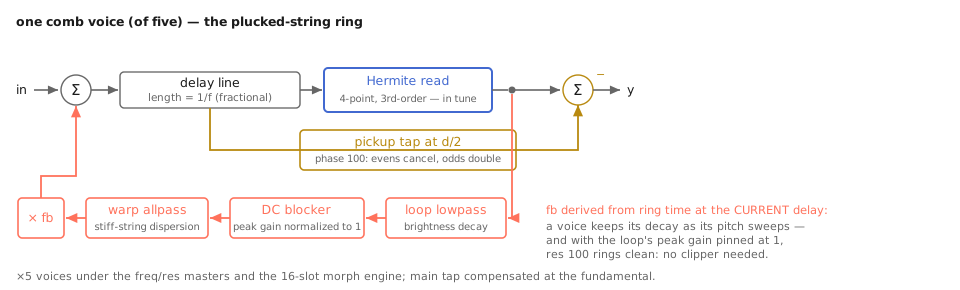
The lowpass is the string's brightness decay: every round trip gets a
little darker, highs first, like a real string. Its coefficient is exact —
m_lp_a[v] = 1 − e^(−2π·fc/m_sr) — placing the −3 dB corner at fc by
construction (the one-step discretization of an RC section). The in-file
comment flags the deviation: tap.comb~ used hz·2/sr, which is not even
the small-argument limit of the exact map (that would be 2π·fc/fs) — its
actual corner lands near fc/π, a factor-of-three tuning error on a labeled
frequency knob. Faithful porting stops where the parameter lies about its
units.
The DC blocker (y = norm·(x − x1) + R·y1, R = k_dc_block_r = 0.999,
norm = k_dc_block_norm = (1+R)/2, ~7 Hz corner at 48 kHz) replaces the
legacy tap.comb~ hard ±1 autoclip — the file's most consequential
retirement. The clipper existed to stop runaway; but a clipper in a resonant
loop is a distortion stage, and at high resonance — precisely where the
GRM sound lives — the legacy object audibly distorted. The modern argument:
cap fb below unity (k_fb_max = 0.99999), kill the loop's DC transmission
(the blocker's zero at z = 1), and the linear loop contracts — no limiter
needed, so res 100 rings clean.
The norm factor is this chapter's own contribution, and the story is worth
a paragraph. The raw blocker (1 − z⁻¹)/(1 − R·z⁻¹) is not passive: its
magnitude peaks at 2/(1+R) ≈ 1.0005 toward Nyquist. While proving the
contraction claim for the first edition of this chapter, the measurement
came back false in one corner: with the loop lowpass wide open the product
|H_lp·H_dc| crossed unity near 450 Hz, and a voice tuned there at res 100 —
where fb saturates at the cap — measurably swelled at ~+0.2 dB per second.
The fix is the normalization: scaling the blocker by (1+R)/2 pins its peak
gain at exactly 1 (the zero at DC is untouched), so with the allpass at unit
magnitude and the one-pole lowpass ≤ 1, the loop gain is bounded by fb alone
and fb < 1 now really is the airtight inequality. A kernel test pins the
formerly-failing corner: 450 Hz, res 100, lp at 20 kHz, twelve seconds of
ring-out, decaying window over window.
The normalization has a side effect the file also pays for: the blocker now
slightly attenuates each voice's fundamental (a few parts in 10⁴ at mid
frequencies, more for very low voices), which — uncompensated — would shave
the top off long ring times. So update_derived divides the RT60-derived fb
by dc_block_gain(ω₀), the blocker's magnitude at the voice's fundamental —
the same pay-the-fundamental-back philosophy as the warp compensation below,
and clamped to k_fb_max so the contraction bound survives. The second new
kernel scenario pins the payoff: an impulse-excited voice at res 50 measures
its RT60 within 10 % of the map's 1.41 s target.
warp: dispersion, and paying the fundamental back
The allpass is the modern GRM Comb's character control. warp sets
m_ap_c = −k_warp_coef_max · warp/100 (c ∈ [−0.85, 0])
and inserts H(z) = (c + z⁻¹)/(1 + c·z⁻¹) into the loop — unit magnitude
everywhere (it cannot alter the decay), pure phase. At c = 0 it degenerates
to z⁻¹, an honest one-sample delay: warp 0 is exactly the harmonic Classic
comb. Its phase delay in samples is what allpass_phase_delay() computes:
τ(ω) = [ atan2(sin ω, c + cos ω) − atan2(c·sin ω, 1 + c·cos ω) ] / ω

τ(0) = (1 − c)/(1 + c)      (the DC limit the w < 1e−9 branch returns)
For negative c, τ falls monotonically with frequency — at c = −0.85, from (1.85/0.15) ≈ 12.3 samples at DC down to 1 sample at Nyquist. A partial's resonant frequency is set by its total round-trip time d_read + τ(ω), so upper partials, seeing a shorter loop, land sharp of the harmonic series — the stretched partials of a stiff piano string, exactly the physics that motivates the control.
Left there, the fundamental would sharpen too. The compensation is one line:
m_d_read[v] = max(d_total − ap_tau, k_min_delay_samples), where
ap_tau = allpass_phase_delay(m_ap_c, 2π·f/m_sr) is evaluated at the
voice's fundamental. The main tap is shortened by precisely the phase
delay the allpass adds at that frequency, so the fundamental's round trip is
d_total again — pitch stays put while the overtones stretch. The max is
the documented physical limit: at extreme warp × high tuning, d_total − τ
falls below the interpolator's 2.5-sample floor, the loop cannot get shorter
than the dispersion, and the pitch flattens — physical, and flagged in the
maxref. The warp scenario pins the endpoints: warp 0 echoes at one period;
warp 100 stays bounded, still resonates, and its tail correlates < 0.5 with
the harmonic tail (a genuinely different spectrum, not a filter tilt).
phase: plucking the string at its midpoint
The output tap is out = y − pickup·read_linear(d_half) with
d_half = d_total/2. Consider loop content at harmonic n of the voice —
frequency n·f, i.e. n·fs/d. Delaying it by d/2 samples shifts its phase by
Δφ = 2π · (n·f/fs) · (d/2) = n·π
Even n: Δφ is a multiple of 2π, the delayed copy equals the original, and the subtraction (at pickup = 1) cancels it exactly. Odd n: Δφ = π, the copy is inverted, and subtraction doubles it. Pickup therefore sweeps continuously from the full series to odd-harmonics-only — plucking a string at its midpoint, where the even modes have a node. The test uses a 1 kHz voice at 48 kHz so the half tap lands on exactly 24 samples; Goertzel measures the 2f-to-f power ratio collapsing below 5% of its phase-0 value.
The parameter engine
All 22 parameters (k_num_params: gain, mix, three masters, warp, phase,
freq/res/lp × 5) ride identical per-sample linear ramps. The bank keeps one
count, m_ramps_active, and one flag, m_derived_dirty; process()
advances only live ramps and recomputes the derived values (taps, fb,
coefficients, mix gains) per sample while anything moves, once when
everything has settled — the same two-tier idea as svf.h's coefficient
cache, so steady state pays nothing for the smoothness.
The 16-slot preset morph is the same machinery pointed at all 22 targets at
once: store_preset() snapshots the ramp targets (knob positions, not
mid-ramp values); recall_preset(slot, seconds) calls ramp_to() on every
parameter over n = seconds·m_sr samples. Because ramp_to() always
retargets from r.current, a recall issued mid-morph — or a single slider
grabbed mid-recall — is continuous by construction; no special case exists.
The scenarios pin it: a 50 ms recall under a running sine produces no
sample-to-sample jump above the click threshold and lands every parameter
exactly on the preset; a mid-morph set_freq() reaches its own value while
the other 21 keep morphing.
The engineering ledger
k_fb_max = 0.99999, applied after the rt60 solve. The cap makes "res 100 = longest possible resonance" a bounded statement; the rt60 math would happily request fb ≥ 1 for rt60 → ∞ (andres_mastercan push res_eff to 200).- Anti-denormal guard (
|x| < 1e−15 → 0, thetap.comb~idiom) on every recursive state — a comb ringing into silence otherwise decays into denormal territory and multiplies its CPU cost at the quietest moment. - Wet 1/5 normalization, a deliberate deviation.
k_wet_norm = 0.2scales the five-voice sum; the legacy abstraction wired fivetap.comb~objects straight into the output gain — a hot sum, +14 dB at full wet. The mix scenarios pin both endpoints: mix 0 is an exact passthrough, and mix 100 with all resonance off passes at unity to 1e−9. - Equal-power mix:
m_dry_gain = cos θ · g,m_wet_gain = sin θ · g · k_wet_norm, θ = mix·π/200 — matchingtap.crossfade~. - The pickup tap is linear-interpolated (
read_linear), not Hermite — deliberate asymmetry: it is a feed-forward output tap, so its droop is applied once, not compounded per round trip; the argument that disqualified linear ford_readdoesn't apply. - Allocation only in
prepare(): oneceil(sr/k_freq_floor_hz)+8buffer per voice (the 5 Hz floor honors the legacy 200 ms buffer). Every setter is a clamp plus a ramp retarget — safe while audio runs.
Checkpoint
A feedback comb is a string, and the file's one structural opinion is that
the string's decay time — not its feedback coefficient — is the musical
truth: fb = 10^(−3·d/(rt60·fs)), re-solved from the current delay so pitch
sweeps preserve the ring. Hermite taps make the tuning real, the exact
one-pole makes the damping knob honest, and the DC blocker retires the
clipper by making high resonance a solved inequality (fine print stated)
instead of a distortion stage. Warp is pure phase — dispersion paid back to
the fundamental through allpass_phase_delay — and phase is pure geometry:
half a loop is nπ, evens cancel, odds double. The rest is 22 ramps and one
dirty flag, and the tests hold every claim.