The acid machine
The Roland TB-303 was designed to imitate a bass guitar, failed completely,
and accidentally defined thirty years of dance music. What makes it
unmistakable is not any one block — a saw into a lowpass is every synth ever
made — but the coupling: accent drives the filter and the amplifier through
shared circuitry with memory across notes, slide is a gate that refuses to
let go, and the envelopes are fixed RC discharge curves with exactly one knob
between them. tap.303~ is a circuit-informed model of that whole tangle;
tap.diode~ is its filter as a standalone object; tap.303.seq~ is the
other half of the instrument. This chapter is what each control trades, and
what the measurements say the model actually delivers.
Companion material: the reference pages and help patchers in the TapTools-Max
package, and two executed verification notebooks —
tb303.ipynb
for the voice and
step_seq.ipynb
for the sequencer — every number below is a measurement from one of them or
from the kernel test suite. Provenance runs through Tim Stinchcombe's filter
analysis, Robin Whittle's Devil Fish documentation, the x0xb0x schematics,
and Robin Schmidt's Open303, whose measured calibrations several constants
adopt verbatim.
What the hardware is, in one paragraph
One saw-core oscillator (the "square" is the saw through a transistor
shaper, not a clean pulse), into a four-stage diode-ladder filter — not
the Moog transistor ladder; the diode ladder's stages load each other, which
is why its resonance is broader, less pure, and entirely its own — then a
one-transistor amplifier. Two envelopes, both decay-only RC discharges: the
Main Envelope sweeps the cutoff (the envmod knob decides how much), the
VCA envelope is fixed. Accent makes the Main Envelope hotter and faster,
routes it into the VCA, and charges a capacitor (C13) through the resonance
pot — and because C13 doesn't fully discharge between closely spaced accents,
runs of accented notes bloom, the famous wow. Slide holds the gate across
the step boundary while the pitch CV glides through a ~60 ms RC. Everything
about a note — pitch, gate, accent, slide — comes from the sequencer, not
the panel. That is why this is three objects, not one.
The filter first: tap.diode~
The panel says "18 dB/oct"; the circuit is four poles whose asymptotic slope is 24 dB/oct with a shallower region near cutoff — Stinchcombe untangled this, and the kernel reproduces his published transfer function to 0.028 dB. Two behaviors are load-bearing and easy to get wrong:
- The resonance feedback runs through a 150 Hz high-pass, so resonance thins as the cutoff drops — low notes squelch, they don't ring. Pinned by test: the ring-down Q falls with cutoff.
- A stock 303 never quite self-oscillates, and neither does this filter
at stock settings. That emerged from the modeled feedback high-pass rather
than being programmed in, and it's documented as a trait, not a defect.
(Push
resonancepast 1.0 — the bend range runs to 1.5 — and it will sing for you anyway.)
Like tap.ladder~ it has a solver choice: fast (default) or exact,
which iterates the re-linearized solve to convergence on the true nonlinear
loop. Measured across a matrix out to
resonance 1.4 and +24 dB drive — beyond anything the hardware can reach —
the two differ by at most −44.9 dBr, at 1.6–3.3× the CPU. The exact
solver is there for the suspicious; the fast one is there for the patch.
oversample (1/2/4, default 2) and a signal-rate cutoff in the right inlet
round out the tap.ladder~ surface.
The voice: tap.303~, knob by knob
The attributes mirror the seven-knob panel; the calibrations are Open303's measured laws.
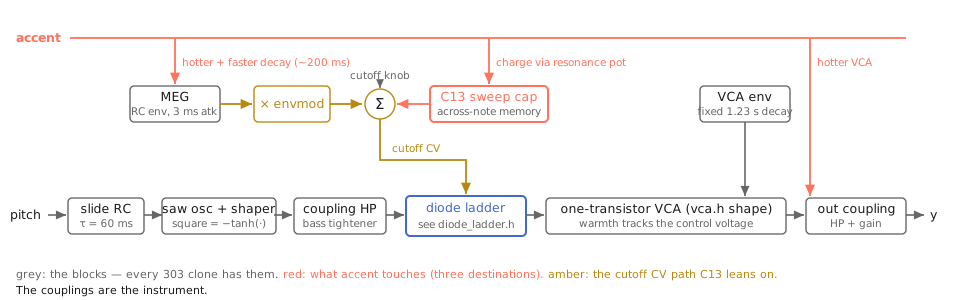
The blocks are ordinary; the red and amber wires are the 303. Accent touches three destinations at once, and C13 remembers across notes — the couplings are the instrument.
waveform—saworsquare. The square is the hardware's shaped saw:−tanh(10^(36.9/20)·saw + 4.37), Open303's measured constants verbatim — rounded and notched, audibly not a 50 % pulse.cutoff— the knob in Hz. Stock travel is the measured 302–2394 Hz; the attribute range (100–5000) is a flagged bend beyond the panel.resonance— 0..1 is stock; up to 1.5 is the bend.envmod— how much Main Envelope reaches the cutoff, with the hardware's measured law: 2/3 of the sweep goes above the knob position, 1/3 below, and the "gimmick" offset shifts the resting point down as you turn it up. The knobs feel right because the interaction is modeled, not just the ranges.decay— Main Envelope decay, 200 ms–2 s. On an accented note the hardware ignores this knob and runs at ~200 ms; so does the model (adjustable via theaccdecaybend, 50–2000 ms).accent— how hard accented notes hit: louder and punchier (the envelope routing), and quackier (the C13 sweep, scaled by the resonance knob). The wow is measured: over a run of closely spaced accents the cutoff peak builds by ×1.94, and decays back within ×0.998 once the accents stop. Consecutive accents at high resonance are the entire genre.tuning,gain— cents and dB. Plumbing.
The envelopes carry the schematic's fixed interrelations: MEG attack ~3 ms,
VCA attack ~3 ms with a measured ~1.23 s decay chopped at gate-off, 50 ms when accented.
None of these have knobs on the hardware, so none of them have knobs here —
except through the documented Devil-Fish-style bends (slide 10–500 ms,
attack 0.3–30 ms, accdecay, and drive ±24 dB into the ladder, where
the diodes compress: +24 dB of gain buys only 9.2× of RMS). All stock at
their defaults.
Phase 2 added vca clean|warm: the one-transistor class-A stage as a
slope-normalized biased saturator, in the hardware's signal order. The
distortion tracks the envelope — measured 5.4 % difference signal on quiet
notes, 11.5 % on hot accents — so warm thickens exactly where the hardware
does. clean (default) is bit-identical to phase 1.
House machinery throughout: seed/tolerance per-unit component spread (an
mc. stack of 303s with different seeds detunes and drifts like a wall of
real units), 16 preset-morph slots with factory acid in 1–8
(squelch, sub, screamer, rubber, knock, bloom, overdriven, glass), and
per-sample ramps on every parameter.
The note interface, and why slide is free
tap.303~ is TapTools' first pitched instrument, and its inlets are the
package-wide melodic contract: pitch as a MIDI note number signal in the
left inlet, gate with amplitude-as-accent in the right — 1.0 is a plain
note, 2.0 fully accented (depth = amplitude − 1). Slide needs no input at
all: a pitch change while the gate is held is a slide — legato, no
envelope retrigger, the ~60 ms RC glide — which is exactly the hardware's
own definition. A note <pitch> [accent] [slide] message covers patching
without signals.
The other half: tap.303.seq~
Half the 303's sound is sequencer behavior, so the sequencer emits the
voice's contract verbatim: a pitch signal and a gate signal, clocked by a
phase ramp (0..1 per pattern, a phasor~). Per step: pitch, gate/rest,
accent, slide. The measured facts, from the sequencer notebook:
- Steps land on the analytic grid within one sample; the gate opens at
the step start and closes at 0.5 of the step (Open303's
stepLength). - A slid step is approached with the gate held: 16 gated steps with 3 slide flags produce exactly 13 note-ons — the other three arrive legato, pitch stepping on the boundary sample, and the voice glides.
- Accented steps gate at 2.0;
transposeshifts live, like the hardware's transpose mode without the mode;swingand pattern slots with cycle-quantizedrecallare shared with the drum rows (next chapter).
The 1981 pitch-mode/time-mode data entry is deliberately not recreated. You keep the data model; you lose the part everyone hated.
When it is not the right tool
- You want a generic bass synth.
tap.vco~+tap.svf~+tap.adsr~give you ADSRs, waveform variety, and a filter that behaves. This object's value is its refusal to decouple. - You want the filter without the biography —
tap.diode~alone, ortap.ladder~if you want the Moog character instead of the 303's. - You want polyphony. It's a monosynth;
mc.gives you many monosynths, which is not the same thing as a polysynth and shouldn't be.
Checkpoint
A diode ladder that matches the published analysis to 0.028 dB and won't self-oscillate until you bend it; a voice whose envelopes, accent path, and C13 memory come from the schematic, with the wow measured at ×1.94 across an accent run; slide as pure gate-hold, so legato falls out of the note contract; and a sequencer that emits that contract sample-accurately. The coupling is the instrument — and every claim above has an executed notebook cell behind it.