The dirt with two stages
Two objects in this library make things dirty and they are not competing.
tap.overdrive~ is a feedback soft-clipper chasing the Tube Screamer
lineage — the nonlinearity sits inside a loop with a lowpass, so the bass
stays clean and the mids break up first. tap.fuzz~ is the other school:
two clipping stages one after the other, and a tone section that scoops the
middle out. It is the OK Computer-era sound — the dirt on Paranoid Android
and My Iron Lung — and it belongs in this part of the book because, like
the tape echo and the stutter, the interesting settings are the ones you
arrive at by moving something.
The method is not invented here. It is the simplified cascade of Yeh, Abel and Smith's DAFx-07 paper on distortion and overdrive pedals: conditioning filter → memoryless nonlinearity → equalization filter, twice. That paper also supplies the licence for the central shortcut. A real diode limiter is not a static curve at all — it is a lowpass whose pole moves with the voltage across it, and solving that honestly is expensive. Approximating it as a fixed curve between fixed filters is defended there, and measured against real pedals.
What this object is not is a model of a specific pedal. No resistor, capacitor or corner frequency in it is claimed as measured from a unit, and the control names follow the layout that class of pedal conventionally carries rather than asserting what any particular one does.
Companion material: the executed notebook fuzz.ipynb, and the
radiohead_render scenarios fuzz_gain_sweep, fuzz_tone and
fuzz_edge_and_bite.
One curve, two knees
Both stages share a single clipping family — tanh(kx)/tanh(k) — normalized
so that full scale in is full scale out at every knee. That normalization
is what lets the knee be a character control instead of a hidden volume
control.
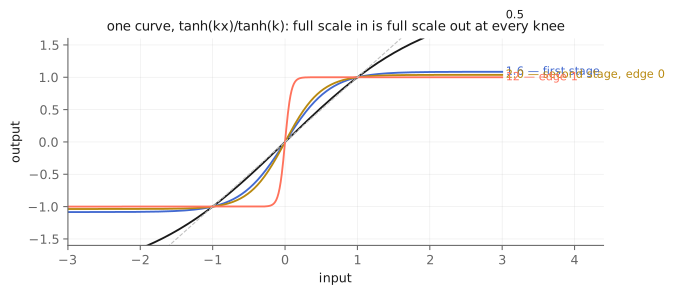
The knee sharpens the corner without moving the ceiling.
The first stage takes a soft knee and most of the gain (the op-amp-ish
stage); the second takes a harder one at unity (the shunt limiter). edge
sweeps the second stage's knee from a gentle limiter toward something close
to a hard corner.
gain — and why the floor is below unity
The knob sweeps the first stage's drive. Its floor sits below unity deliberately, and the reason is the most useful thing in this chapter if you ever build a cascade of your own.
The tanh family's small-signal gain is k/tanh(k) — greater than one, and
growing with the knee. Put a fixed ×2.2 in front of a knee-3 curve and the
second stage sees an effective ×6.6, which means it is fully clipped before
the gain knob leaves zero. That is exactly what the first version of this
kernel did. It sounded like a distortion at every setting, which is precisely
why listening did not catch it and a measurement did.
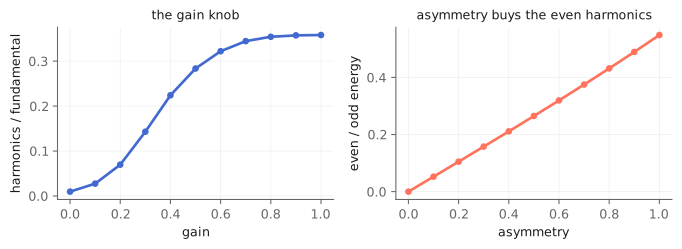
Left: the gain knob after retuning — harmonic content sweeps 0.010 to 0.358. Right: asymmetry is what makes even harmonics.
asymmetry — the even harmonics
A symmetric curve is an odd function, so it can only make odd harmonics. DAFx-07 points out that a real op-amp stage clips lopsided, and that this is where a pedal's even-order content comes from — which is the whole reason this control exists. Turn it up and the even/odd ratio climbs from essentially zero to about 0.55.
It costs no DC. The bias is applied inside the curve and corrected at the stage output, so however lopsided the setting, silence in is exactly silence out — no pedestal, no thump when you stop playing.
bass, treble, contrast — the voicing
Three linear filters entirely outside the nonlinearity: a low shelf, a high
shelf, and a mid scoop whose depth is contrast. On this class of pedal the
voicing section is most of the identity — the scoop is the sound people mean
when they describe it — so it is a first-class part of the object rather
than an afterthought bolted on at the end.
oversample — and a default that was wrong twice
A static curve makes harmonics without limit, so anything above Nyquist folds back. The clipper pair therefore runs oversampled. Everything about this control has been re-measured, because the first two conclusions drawn from it were wrong, and wrong in the same way.
First, the anti-alias filter here is 8th order, where the rest of the house uses 4th. Measured in this kernel the 4th-order pair is not steep enough — alias energy at 4× came out worse than at 2×.
Second, the chain is a cascade of 2× stages — one doubling, one filter, repeated — rather than a single zero-stuff by the whole factor. That is what finally made more oversampling mean less aliasing. The single-stage chain left N−1 images for one filter to suppress at a corner that got tighter with every doubling, and the residue intermodulated in the clipper into exactly the non-harmonic junk the probe measures. Cascading removes the reversal outright, and where 4× and 8× used to be merely adequate they are now two to four orders of magnitude cleaner. It costs about 5 % more CPU at 8×.
Third — and this is the part worth taking away — the old default came from a single test tone. Every number in the original write-up was measured at 3733 Hz, and 2× happens to look best there. Swept across tones, 2× collapses above about 6 kHz; at 10.5 kHz it is worse than not oversampling at all, because the clipper's low harmonics already exceed the base Nyquist and one doubling does not move them out of the way.
| input tone | 1× | 2× | 4× | 8× |
|---|---|---|---|---|
| 3733 Hz | 1.2e-1 | 3.0e-5 | 2.1e-5 | 2.2e-5 |
| 5171 Hz | 1.5e-1 | 3.3e-4 | 2.0e-7 | 1.9e-7 |
| 6421 Hz | 8.5e-2 | 3.2e-2 | 3.9e-7 | 3.6e-7 |
| 8123 Hz | 9.0e-2 | 7.8e-2 | 1.1e-3 | 2.0e-5 |
| 10499 Hz | 1.5e-1 | 1.7e-1 | 1.2e-5 | 1.6e-6 |
So: 4× is the default. More is never worse now, and 4× is indistinguishable from 8× below about 7.5 kHz. Above that, harmonics start folding inside the 4× band before decimation — 8123 Hz in the table is that happening — and 8× is worth the extra 1.4 % of a core.
Use 2× only if you have measured your own material and it holds up there. It is kept because it is cheap and because on a bass-heavy source it is fine, not because it is good.
Recipes
- Edge of breakup:
@gain 0.3 @edge 0.2 @contrast 0. @bass 0.. Barely dirty; a boost with attitude. - The scoop:
@gain 0.8 @edge 0.6 @contrast 1. @bass 0.4 @treble 0.2. The sound the control is named for. - Lopsided and mean:
@gain 0.9 @edge 1. @asymmetry 0.7 @oversample 8. Hard knee plus even harmonics, and 8× because a hard knee on a bright source is exactly where the top octave folds. - Into the echo:
tap.fuzz~→tap.tapecho~with the echo's@drivelow. Two saturators in series get muddy fast; let the pedal be the dirt and the tape be the space.
When it is not the right tool
- Amp-like breakup.
tap.overdrive~keeps the bass clean by design; this object does not, and hard settings will get woolly on a bass-heavy source. - Subtle warmth. Two stages is a lot of stages. At low gain this is a
clean boost with a tone stack, which is fine, but
tap.overdrive~is the better instrument for gentle. - A specific pedal. This is that pedal's class. If you need a named unit, this is not it and does not pretend to be.
Checkpoint
One clipping family with a knee control, cascaded twice, into a voicing
section that scoops the middle. The gain knob's floor is below unity because
small-signal gain compounds through a cascade — a lesson that cost this
kernel one wrong first draft. asymmetry is the even-harmonic control and
costs no DC. And the oversample setting is a
measurement twice corrected: cascaded 2× stages, because a single zero-stuff
by N was what made bigger measure worse — and a default of 4× rather than 2×,
because the old default had been generalized from one test tone. Every number here
lives twice, as a cell in fuzz.ipynb and as a pinned scenario in
tests/fuzz_test.cpp.