The spiral staircase
Most pitch shifters are a one-way trip: in, transposed, out. The GRM Tools
"PitchAccum" closed the loop — the transposed signal is delayed and fed back
into the transposer, so every pass around the loop shifts it again. Set
+7 semitones and a note becomes a rising spiral: +7, then +14, then +21, each
echo climbing, the whole thing dissolving upward like light on water. That
loop is the effect everyone now calls shimmer, years before the name.
tap.pitchaccum~ is the recreation: two independent transposer-delay loops
("shadows") with the accumulation wired in. This chapter is how to climb.
Companion material: the reference page and help patcher in the TapTools-Max
package, and the grm_pitchaccum_render tool in the kernel repo for
listening checks outside Max.
The loop, and why it doesn't collapse
Each shadow is: granular transposer (±24 semitones) → delay (up to 3 s) → feedback → back into the transposer. Three design choices keep the spiral musical instead of muddy:
- Constant-level grains. The transposer sweeps two taps half a cycle apart, each windowed so the pair sums exactly to 1 at every phase and every crossfade width. The original tt_shift engine's window pair didn't quite sum flat, which imposed an amplitude ripple at the grain rate — after ten trips around a feedback loop, ripple compounds into tremolo. Here the tenth pass is as steady as the first.
- Hermite-interpolated taps. Fractional delays keep each pass in tune, so the spiral's steps are the interval you set, not the interval plus drift.
- A capped, DC-blocked loop. Feedback tops out at 0.99 with a DC blocker in the path — the spiral can run for a very long time, but it is unconditionally bounded (unit-tested at the cap).
The signature is measurable: set +7 semitones and the kernel test finds energy at +7 and +14 — the second pass, the accumulation itself.
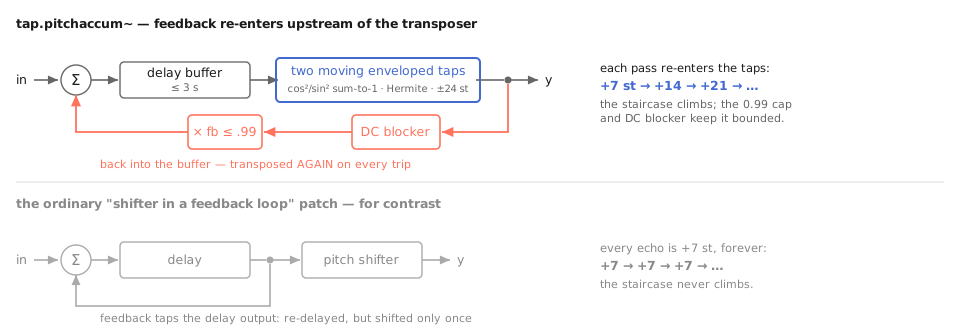
The topology is the effect. Feedback re-enters upstream of the taps, so the staircase climbs; in the ordinary patch every echo is the same interval.
The knobs, one by one (per shadow, ×2)
trans1 / trans2 — the step of the staircase
±24 semitones, continuous. Musical intervals (+7, +12, +5) make harmony; small offsets (±0.1–0.3 st) make lush detune-echo instead of a spiral; negative values descend into the dark version nobody expects.
delay1 / delay2 — the tread depth
Up to 3 s per shadow. Short (50–150 ms) blurs the passes into a texture; long (0.5–2 s) articulates each step of the climb as an audible echo.
fb1 / fb2 — how many steps
How much survives each trip, 0–99. 30 gives two or three audible generations; 70 a long climb; 90+ a texture that essentially sustains until the transposition walks it out of range (energy shifted past the audible band is the spiral's natural exit).
xfade — the grain crossfade
GRM's Cross-fade control: the width of the grain envelope's flanks. Narrow is more articulate and more grain-rate flavored; wide is smoother and softer in attack. Because the envelope pair always sums to 1, this changes texture, never level.
The modulation section, and follow
A global LFO (with modphase offsetting shadow 2, so the two loops breathe
against each other) plus per-voice deterministic random transposition
modulation — a little of either keeps long spirals from sounding cloned.
follow (off by default) engages a pitch follower — decimated normalized
autocorrelation, confidence-gated, deliberately picking the smallest
plausible lag so it doesn't lock onto subharmonics — which adapts the grain
window toward the detected period: cleaner transposition on monophonic
sources, ignored gracefully on noise.
Presets
The sixteen-slot morph engine, as everywhere in the GRM pair: two stored
spirals and a timed recall between them is a gesture in itself.
Recipes
- Shimmer, the classic: shadow 1 at +12, delay ~400 ms,
fb1 75; shadow 2 at +7, delay ~650 ms,fb2 60; both into a reverb (tap.convolve~with a long church, ortap.verb~). The reverb is load-bearing — shimmer is spiral plus wash. The full patch has its own recipe in Part IX. - The descent: −5 and −12, long delays, moderate feedback — a staircase into the basement, much rarer and much creepier.
- Micro-thickener: ±0.15 st, 60/90 ms delays, feedback 50,
xfadewide — not a spiral at all, just an expensive-sounding widener.
When it is not the right tool
- One clean transposition, no loop:
tap.shift~is the plain shifter — same modernized engine, none of the plumbing. - Formant-true vocal shifting: granular transposition shifts formants
with the pitch; chipmunks live this way.
tap.harmony~is the dedicated tool — formant-preserving voices at fixed intervals, chords included. - Rhythmically exact multi-tap echoes: the delays here serve the loop;
tap.multitap~serves the grid.
Checkpoint
Two transposer-delay loops where the feedback re-enters the transposer, so pitch accumulates pass after pass — +7 becomes +14 becomes +21. Constant-sum grain envelopes keep the tenth pass as steady as the first; Hermite taps keep it in tune; the capped, DC-blocked loop keeps it bounded forever. Intervals are the architecture, delay is the pacing, feedback is the height — and the morph engine turns the whole staircase into something you can bend mid-climb.