Time as a function of phase: step_seq.h
The sequencer header is the smallest DSP file in the kernel and the one whose central decision does the most work per line: the engine owns no clock. It is handed a phase — a number in [0, 1) meaning "here is where we are in the pattern" — and everything else (the current step, whether this sample is a boundary, how far through the step we are) is derived from it, statelessly, every sample. This appendix explains why that one decision buys sample accuracy, polymeter, scrubbing, and drift-free multi-row lock for free, and then walks the three pieces built on it: the swing warp, the two emitters, and quantized recall.
Verification lives in two places:
tests/step_seq_test.cpp
(19 Catch2 scenarios, including a pairing test against the real
tb303_voice.h) and the executed
step_seq.ipynb.
The design of record is plans/tap.seq.md in the Max package repo.
Deriving the step, in O(1)
Ignore swing for a moment and the whole clock is one line:
k = floor( wrap(phase) · length )
Swing delays each odd-numbered step's start by swing/2 of a step, so the
start of step k is
start(k) = ( k + (k odd ? swing/2 : 0) ) / length
and the derivation gains one correction: compute the naive k, and if it is
odd but the fractional position hasn't yet reached swing/2, the sample
still belongs to the (even) step before it. Two comparisons, no search —
the boundaries are monotone, so the correction is exact.
A step entry is simply k != k_previous. That definition, rather than
"the clock ticked," is what makes the engine indifferent to how the phase
moves: run it backwards and entries still fire (pinned by test); jump it
and the landing step fires once; feed it a constant and nothing happens
after the first sample. reset() just forgets k_previous, so a transport
start fires its downbeat.
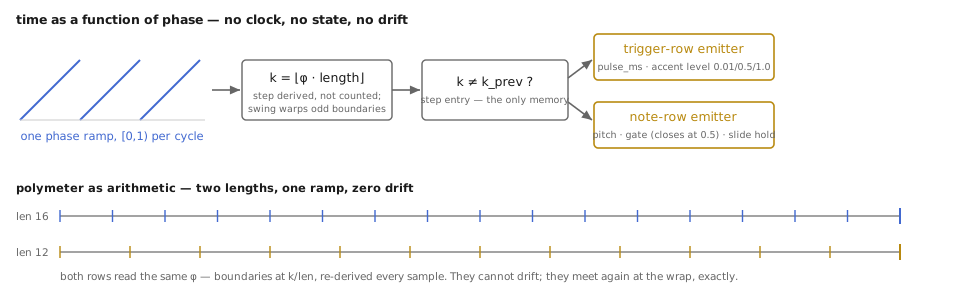
The one decision the file turns on — and polymeter falling out of it as arithmetic.
Why phase, not a pulse clock
The alternative — count incoming clock pulses — is how most step sequencers are built, and every one of them then grows a reset input, a position protocol, and a drift story. Deriving from phase dissolves all three:
- Sample accuracy is inherited from the phase source. The notebook measures trigger edges landing within one sample of the analytically computed boundaries — the one sample being float rounding at the boundary itself, not accumulated error.
- Multi-row lock is structural. Two rows fed the same ramp cannot drift, because neither owns any timing state that could drift. Mute one for an hour; it re-enters in place.
- Polymeter is arithmetic. A
length 12row againstlength 16rows off one ramp divides the same cycle differently — 12 and 16 entries per cycle, measured. The TR-808's triplet "pre-scale" falls out as a special case. - Position is explicit. Scrubbing, reversing, and jumping are the caller's choices about the ramp, not features the engine implements.
The cost is honest too: the engine cannot free-run. That is deliberate —
phasor~ (transport-locked or not) already exists, and a sequencer that
owns tempo is a sequencer that fights the transport.
Position within the step, and the gate duty
The tick also reports pos — the fraction of the current step's actual
(swung) span elapsed — computed from the same start() function. Gate
timing hangs off it: the note row closes its gate at pos ≥ 0.5, the
pinned Open303 duty. Measuring duty against the swung span rather than the
nominal step means gates never collide however hard the swing is pushed.
The trigger row: an impulse and a re-arming gap
trigger_row is the small emitter: on entry to a sounding step, emit the
step's velocity for one sample (or pulse_ms worth, for envelope
consumers), else zero. The single-sample default is a contract, not a
simplification: every downstream tap.808.* voice re-arms its edge
detector below 1e-3, and the test suite pins that two adjacent sounding
steps produce two clean detectable edges. The header documents the one way
to defeat this — a pulse_ms longer than a step merges back-to-back
triggers — rather than silently preventing it.
The note row: a five-state sentence
note_row implements the tap.303~ contract, and its entire behavior fits
in one paragraph of code. On entering step k: if the step is gated and its
slide flag is set and a note is already sounding, change the pitch
output and leave the gate level alone — that is legato, and the voice's RC
does the glide. If gated without that condition, set the gate to 1.0 (2.0
if accented) — a fresh edge. If not gated, drop the gate. Between entries:
close the gate at the duty point unless the next step is gated and
slid — that look-ahead read is the gate-hold, and it is read live from the
pattern each sample so an edit lands immediately.
Three edge cases are worth naming because the tests pin them:
- Slide from a rest is a plain trigger — there is nothing sounding to
slide from, so the flag degrades gracefully (the voice's
notemessage behaves identically). - Chained slides chain — each held boundary defers the duty close to the next step, so a run of slid steps is one unbroken gate. Sixteen gated steps with three slide flags produce exactly thirteen note-ons, measured.
- The wrap is a boundary like any other — a slide from step 15 into step 0 holds across phase 1→0, because nothing in the derivation treats the wrap specially.
One convention deserves its provenance note: the slide flag sits on the
target step (the note being slid into), matching the package's
note <pitch> [accent] [slide] message and the original interface dry-run.
The hardware stores the flag on the source note ("slide to next"). The
data models convert trivially — shift the flag column by one — and the
divergence is documented in the header rather than discovered by a user.
Quantized recall: swap on the boundary sample
Patterns live in 16 slots. recall arms rather than acts (unless
quantize now): the armed slot is applied on the next cycle entry (step 0)
or step entry, and — the detail that keeps it exact — the engine then
re-derives the current step against the new pattern's grid on that same
sample, since the new pattern may have a different length. The notebook
pins the semantics end to end: armed mid-cycle, the running pattern
finishes its bar at its own amplitudes, and the first trigger after the
wrap carries the recalled pattern's. That one message is the TR-808's
A/B-half and basic/fill switching.
What is deliberately absent
No randomness (bit-exact by construction, still pinned by test, because
invariants that aren't tested rot). No allocation after prepare() — the
pattern store is a fixed 64-step array times 16 slots. No run/stop, no
direction modes, no ratchets: the first two belong to the phase source, and
the last is a future emitter, which is the point of the next paragraph.
The engineering ledger
- Engine/emitter split. The clock math lives once;
trigger_rowandnote_roware each a screenful. A future row flavor — CV, probability, ratchet — is another emitter, not another clock. This is also why the Max-side question "one generic object or two family objects?" could be answered by product taste rather than by implementation cost. - Look-ahead vs. cached hold. The gate-hold could cache "next step slides" at entry; reading it live costs one array access per sample and makes pattern edits take effect mid-step. Cheap beats stale.
- Sample-resolution boundaries. Sub-sample trigger placement (fractional
edge amplitudes à la BLEP) was considered and declined: the consuming
voices detect edges at sample resolution, so sub-sample machinery would
add complexity no consumer can observe. If a future voice interpolates
its trigger time, the
tickalready carries the information needed to add it. - The armed-recall re-derivation. The subtle bug in naive quantized recall is applying the swap after deriving the step, leaving one sample computed against the old grid. Applying, then re-deriving within the same call, is two extra lines and the difference between "exact on the wrap sample" (measured) and "usually fine."
Checkpoint
A sequencer that is a pure function of phase plus a pattern: one line of derivation, one comparison for swing, entry as inequality — and from that, sample accuracy, polymeter, reversibility, and drift-free lock without a clock to maintain. The rows translate steps into the two shipped voice contracts, with slide as a held gate and a live look-ahead; recall swaps patterns on the exact boundary sample. Nineteen scenarios and an executed notebook agree, and the most satisfying number in either is small: thirteen note-ons, for sixteen steps, three of which arrived without knocking.