The note you meant
Every sung note is two notes: the one that happened and the one you meant.
tap.tune~ measures the distance between them and closes it — how fast it
closes it is the whole instrument. Closed slowly, nobody knows it was there.
Closed instantly, everybody knows: that snap is the most famous vocal
effect of the last twenty-five years. One object, one time constant, both
worlds.
A short history matters here, told plainly. The classic pipeline — detect
the pitch, snap it to the nearest allowed note, retune by time-domain
resynthesis — was patented in 1998 and the patent expired in 2018, which is
why a whole field of tuners exists today and why this object can implement
the technique from the literature. The famous product name remains a live
trademark, which is why this object is called tap.tune~ and this chapter
says "hard snap" instead. And editing individual notes inside a chord
remains patent-fenced territory — tap.tune~ is monophonic by design, not
by omission. (None of this paragraph is legal advice; the project's own
ship-gate is a freedom-to-operate review.)
Companion material: the reference page and help patcher in the TapTools-Max
package, the runtime maxtest, and two executed notebooks — tune.ipynb
here and pitchshift.ipynb in the DspTap repo — that measured every claim
below.
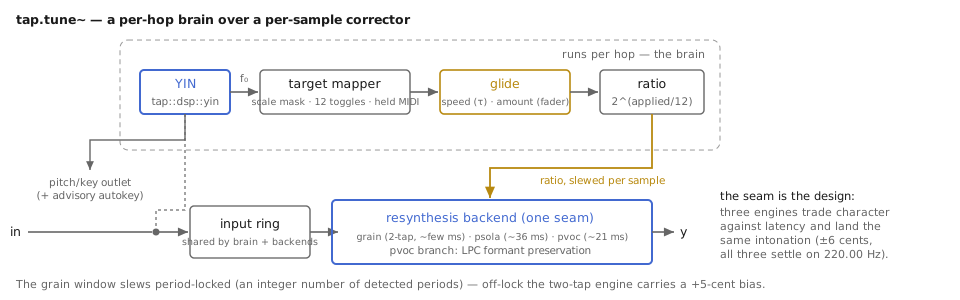
A per-hop brain over a per-sample corrector, with one seam where three resynthesis engines interchange.
The knob that is the instrument: speed
speed is the time constant, in milliseconds, of the glide onto the target
note.
- 0 ms — the hard snap. The correction lands within a detection hop (~5 ms). Vibrato gets quantized into terraces; note transitions become instant staircase steps. This is the effect, worn on the outside.
- 10–40 ms — classic correction. Fast enough that a listener hears "a singer with good intonation," slow enough that the attack of each note — where identity lives — is not robotic. The default is 20.
- 100 ms and up — intonation leaning. The corrector arrives so late it only tames drift; vibrato passes through nearly untouched.
The notebook's pitch-track figure shows all three glides onto the same
46-cent-sharp note; the kernel test pins the exponential's arrival. There is
also amount (0–100%): a fader on the correction distance itself. 100
lands on the target; 50 splits the difference — a gentler kind of honesty
that keeps a performance's shape while shrinking its errors.
Telling it what is allowed
The corrector never invents a target; it snaps to the nearest note you allowed.
key+scale— the usual contract:@key d @scale majorand every detected pitch pulls toward the nearest D-major degree. Presets: chromatic, major, minor, harmonic, melodic, pentatonic, minorpentatonic.notes— the twelve toggles, absolute pitch classes C through B, panel-style:notes 1 0 0 0 1 0 0 1 0 0 0 0snaps everything to a C-major triad, which is less a correction than an arrangement decision.mode midi— the target is the nearest currently held MIDI note (note 64 100holds E4; velocity 0 releases;flushclears). Hold one note and everything becomes that note; hold a changing chord's roots and the corrector is suddenly a performable melody-mangler. No notes held means no correction — the object never guesses.
An empty mask behaves the same way: nothing allowed, nothing changed.
Three engines, one corrector: backend
Detection, targeting, and the glide are shared; only the resynthesis swaps. All three land the same intonation — the notebook drives the same vibrato "voice" through each and all three settle on 220.00 Hz — so the choice is about character and latency, not accuracy.
| backend | what it is | choose it for | latency @ 48 kHz |
|---|---|---|---|
grain | two-tap delay-line, window locked to the detected period (the tap.shift~ engine) | the default; lowest latency, waveform-preserving, happy on any material | a few ms |
psola | true TD-PSOLA | voice — it preserves formants by construction | ~36 ms |
pvoc | peak-locked phase vocoder | dense, harmonically rich material; pairs with formant | ~21 ms |
Switching live is click-safe: the incoming engine starts from silence and
fades in rather than splicing stale audio. One honest caveat per engine:
grain colors sustained unpitched input with a mild moving comb (the
known trade of its class); psola wants harmonic material — on a pure
sine shifted far, its output legitimately thins (the machine chapter
explains why that is the same property as its formant preservation);
pvoc smears sharp transients slightly, as every phase vocoder does.
Keeping the singer's mouth: formant
A correction of thirty cents moves formants thirty cents — nobody hears it.
A MIDI-mode command of five semitones moves them five semitones — everybody
hears it; that is the chipmunk. @formant 1 enables LPC formant
preservation on the pvoc backend: the pitch moves, the vocal tract's
envelope stays where the singer put it. The notebook corrects a synthetic
voice up 5.5 semitones both ways; with the flag on, the formant bump stays
put (band-energy ratio 730:1 in its favor). psola needs no flag — formant
preservation is its resampling rule — and grain ignores the flag.
Letting it find the key: autokey
@autokey 1 starts a learner: every voiced detection drops its pitch class
into a histogram that forgets with about a minute of memory, scored against
the published Krumhansl–Kessler key profiles. Two design decisions worth
knowing:
- It never acts on its own. A key estimate that silently re-aimed your
targets mid-phrase would be a bug wearing a feature's clothes.
getkeyasks (the right outlet answerskey d major 0.95, orkey nonein the first half-second);applykeyadopts the estimate into thekeyandscaleattributes — visibly, where you can see and undo it. - It forgets on purpose. The one-minute memory means a modulation stops arguing with the old verse about as fast as you stop playing it.
The kernel test plays a D-major scale and reads back D major at 0.95 confidence; an A harmonic-minor melody reads as A minor.
The right outlet
While the input is voiced, the right outlet reports
pitch <midi> <hz> every @interval milliseconds (default 50; 0 disables;
a pitch -1 0 marks the end of voicing). That is a free tuner display, a
melody recorder, or the control signal for whatever you want to drive with
the singer's pitch — and it is the same detector the corrector itself uses,
so what you see is what it acted on.
Recipes
- Invisible repair:
@scale major @key(your key)@speed 25 @amount 80. The 80 keeps a little humanity in the intonation; nobody will name what changed. - The famous one:
@speed 0 @scale minorpentatonic. Fewer allowed notes make the terraces wider and the snap prouder. Add melisma. - One-note choir:
@mode midi @speed 5, hold a note, feed it speech. Everything becomes chant on that pitch. - Formant-true transposer:
@mode midi @backend pvoc @formant 1 @speed 10, play a melody against a held vocal — a harmonizer that keeps the singer's identity. - Tuner display only:
@amount 0 @interval 20— the object corrects nothing and the right outlet becomes a clean pitch stream.
When it is not the right tool
- Chords. The detector is monophonic; a chord reads as garbage or as its loudest note, and per-note polyphonic editing is deliberately out of scope (see the history paragraph). Split voices first, or don't.
- Drums, breath, speech consonants. Unpitched input passes through with no correction — by design — but the grain engine adds its mild comb coloration to sustained noise. For processing unpitched material there are better rooms in this house.
- Creative shifting. If the goal is an interval rather than
intonation,
tap.shift~is the plain shifter,tap.harmony~the formant-preserving chord stack, andtap.pitchaccum~the spiral;tap.tune~always measures first and that measurement is latency you don't need.
Checkpoint
Detect, snap to the nearest allowed note, glide at speed — that is the
whole machine, and speed is the dial between honesty and effect. Targets
come from key + scale, twelve toggles, or held MIDI notes; three resynthesis
engines trade character against latency while landing the same intonation;
formant keeps the singer's mouth in place when corrections get big;
autokey learns the key but only ever suggests. The right outlet tells you
what it heard. And when the input isn't a single pitched voice, the honest
move — which the object makes — is to change nothing.