The drum machine
The Roland TR-808 is the most thoroughly analyzed drum machine in the
academic literature, and the reason is charming: the whole instrument is
analog synthesis. No samples anywhere — every sound is a small circuit, and
most of them are variations on about four ideas. The tap.808.* family
recreates the eight voice channels circuit block by circuit block, one
external per channel, and tap.808.seq~ supplies the machine's other half
as one sequencer row per patch cord. This chapter is the family tour: the
shared trigger contract, each voice's character and knobs, and the
calibration pass against a real unit that the numbers come from.
Companion material: each voice's reference page and help patcher, the family
overview patcher (tap.808.maxhelp — all eight voices sequenced off one
phasor~), the
tr808_calibration.ipynb
notebook, and the
step_seq.ipynb
sequencer notebook. Provenance runs through the Werner–Abel–Smith papers
(DAFx-14 and companions) and the TR-808 Service Notes, read component by
component; every magic constant in the kernel headers carries its schematic
designator.
One trigger to rule them all
On the hardware, every voice hangs off a common trigger bus: the CPU's 1 ms
pulse rides a voltage between 4 and 14 V depending on the accent circuit,
and a hotter pulse excites each circuit harder — more punch, slightly
different timbre — not merely louder. The family keeps that literally:
every voice fires on a signal rising edge, and the edge's amplitude
(0..1) is the accent, mapped onto the 4–14 V bus. bang and
trigger 0.7 messages cover the scheduler side. Filter states persist
across triggers, so fast rolls interfere with the ringing tail like the
hardware — no machine-gun effect. And because the excitation is a voltage,
anything that makes an edge can play the kit: a click~, an envelope, a
tap.303.seq~ gate, or the row object built for the job.
The voices
tap.808.kick~ — the bridged-T with a biography
The bass drum is a damped bridged-T resonator (~49.4 Hz from the modeled
component values; Roland's chart optimistically says 56, real units measure
as low as 48) with three behaviors that make it the kick, all emergent
from the modeled schematic: for the first ~6 ms the envelope saturates Q43
and the resonator sits near ~129 Hz — the attack punch, which is a
different mechanism from the famous downward pitch "sigh" (leakage through
R161, the paper's fitted nonlinearity); and a retriggering pulse re-excites
the center node as the envelope collapses so the note doesn't step down.
Panel knobs: decay (seconds of ring at the top), tone (click at ~7 kHz
down to ~300 Hz), level. Paper-documented bends, stock by default:
tuning, pulse, sigh, attack — turn sigh 0 and the pitch relaxation
disconnects, exactly as the bend does on the bench.
Calibration: against a real unit's knob-gridded sample set, the fundamental sat within 2.4 % at every tone/decay position and the −40 dB decay endpoints within 6 % (72 ms → 2.36 s measured, 69 ms → 2.42 s modeled) — no constant needed changing.
tap.808.snare~ and tap.808.clap~ — resonators plus noise
The snare is two bridged-Ts (the late-revision ~173/336 Hz pair) with a
trigger divider and the "snappy" path — enveloped noise, band-limited around
4 kHz to the measured unit. Fundamentals calibrated within 1.2 %, including
the mode flip at tone-max. The clap channel (@model clap|maracas) is the
Service Notes' Figure-13 circuit: band-passed noise near 2 kHz through a VCA
driven by a three-teeth sawtooth retrigger — the "multiple hands" transient —
plus the Q70 reverberation tail. The maracas mode is the same noise voiced
short and bright.
tap.808.hat~ and tap.808.cymbal~ — the metal bank
Six Schmitt-trigger square oscillators (205.3, 369.6, 304.4, 522.7 Hz plus
the two trimmer-tuned at 800 and 540, duty 47.98 %) feed two bandpass
voicings near 3.4 and 7.1 kHz. Werner et al. measured that resistor variance
puts any given unit up to ~20 % off those frequencies — which is why no
two 808s' cymbals sound alike, and why seed/tolerance exists: every seed
is a different unit off the line, and an mc. stack of cymbals decorrelates
like real hardware. The hats are one object with two trigger inlets
because on hardware they are one circuit with two envelope paths and a
choke — closed chokes open (the Q23/R173 path), pinned by test, and
unimplementable as separate externals. Open-hat decay spans the chart's
90–600 ms; the cymbal's two separately enveloped bands cover its 350–1200 ms
"sizzle" span. tap.808.cowbell~ taps just the 540/800 pair into the ~860 Hz
voicing with a two-slope envelope; more cowbell is a patching decision.
tap.808.tom~ and tap.808.rim~ — the resonator variations
Six sounds on two objects, as the hardware switches them: @size low|mid|high
× @model tom|conga. Congas are the tom circuit without its noise layer,
tuned differently; the toms add the D80/D81 attack pitch fall and a pink
noise layer. The rim channel is @model rimshot|claves: the rimshot's
~1667 + 455 Hz crack with the swing-VCA's harmonics, versus the claves' pure
~2500 Hz tick. Tunings sit within ~4 % of the measured unit.
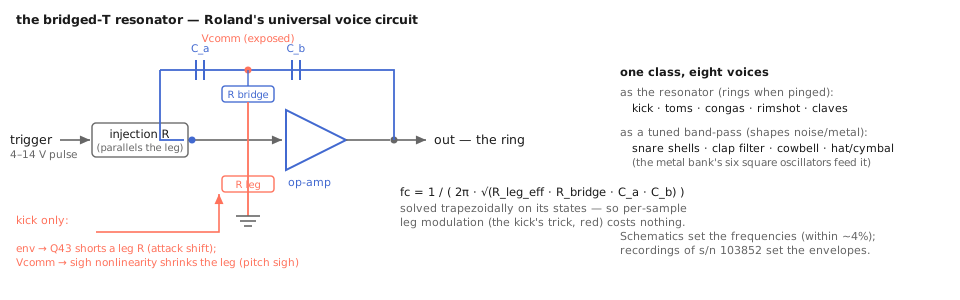
Roland's universal voice circuit. Eight voices, one network — the kick earns its punch by modulating the leg per sample.
The calibration pass, honestly
The §7.2 calibration ran against a real TR-808 (s/n 103852) recorded from the individual outs with knob positions encoded in the filenames — a 0/2.5/5/7.5/10 dial grid, 116 samples — which upgraded "sounds right" to a quantitative per-knob-cell comparison. Identical measurements (spectral-peak fundamental, −40 dB decay, power centroid) ran on both sides. The pitches were already right nearly everywhere; what the pass actually changed was time: tom, conga, cowbell, and clap tails roughly doubled to match the unit, the snappy was band-limited and re-enveloped, the rimshot re-voiced low-dominant, the cymbal's decay span corrected. Each kernel header carries its residuals. The lesson generalizes: schematics get you the frequencies; recordings get you the envelopes.
The other half: tap.808.seq~
One row of the 16-step sequencer, as an object: feed it a phase ramp (0..1
per pattern, a phasor~) and it emits trigger impulses whose amplitude is
the step's accent — the family contract, straight into any voice. Twelve
rows off one phasor are the hardware's panel, sample-locked forever; the
accent row falls out of giving every row the same accents list. The
measured facts, from the sequencer notebook: steps land on the analytic grid
within one sample; the pinned levels are plain 0.01 (the 4 V base — an
un-accented hit still strikes the circuit) and accented 0.5 (the accent
knob at noon; 1.0 is the full 14 V); swing delays the off-16ths by exactly
swing/2 of a step; a length 12 row against 16s is the triplet pre-scale
generalized to polymeter; and pattern slots with cycle-quantized recall
are the A/B-half and fill switching as one message. pulse widens the
impulse into a held gate when you'd rather drive tap.adsr~ than a drum.
When it is not the right tool
- You want a kick, not the kick. A sine with an envelope is cheaper and takes EQ more politely. This family's value is the circuit behavior — the attack jump, the choke, the accent-as-voltage.
- You want your own drum sounds. These circuits are what they are;
seed, the documented bends, and the panel knobs bend them, but a sampler is a sampler. - You want 909 hats. The 909's metal is sampled; this machine's is six square waves. Different instrument, different chapter, maybe someday.
Checkpoint
Eight channels, four circuit ideas — bridged-T resonators, a shared metal bank, noise paths, swing-VCAs — under one amplitude-as-accent trigger bus, calibrated per knob cell against a real unit and honest about what changed (the tails) and what didn't (the tunings). The hats choke because they share a circuit; the cymbals decorrelate because resistors do; and the sequencer row emits the same voltage idea the voices drink, so the whole kit runs off one phasor ramp. The machine's two halves, both measured.