The transistor ladder
Some filters are tools; this one is a character actor. The four-stage
transistor ladder — the Moog circuit — colors everything it touches: the
resonance pushes back against the bass, the stages saturate into one another,
and at the top of the resonance range it stops filtering and starts singing.
tap.ladder~ is a zero-delay-feedback model of that circuit with a tanh
saturator in every stage. This chapter is what each control trades, and what
the measurements say the model actually delivers.
Companion material: the reference page and help patcher in the TapTools-Max
package, and the verification notebook —
every number below is an executed measurement. For the linear ladder — the
cheap, polite Stilson/Smith model — see tap.fourpole~; this object is its
nonlinear sibling.
What the model gets right
Two things separate a serious ladder model from a filter with a "Moog" label:
- Tuning that survives the top octaves. The classic digital shortcut goes audibly flat as the cutoff rises. This model is prewarped ZDF: measured self-oscillation lands at 1000.2 Hz for a 1 kHz cutoff (0.02 % error) — and, the part that's actually hard, 8009 Hz for an 8 kHz cutoff (0.11 %). You can play the resonance like an oscillator anywhere on the keyboard.
- Nonlinearity inside the loop, not bolted on. Each stage saturates, and the feedback fights the saturation the way the hardware does. That is where the compression, the "sag," and the bounded self-oscillation come from.
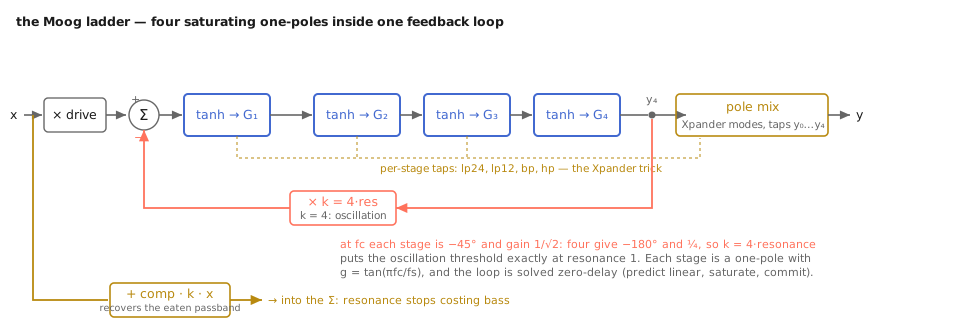
The whole filter: four stages, one loop. The red tap sets resonance, the amber paths are the comp bargain and the Xpander mode taps.
The knobs, one by one
frequency and the right inlet
Cutoff in Hz; a signal in the right inlet drives it with true per-sample
resolution. Like everything here it rides the smooth ramp when set by
message.
resonance — up to and past the edge
0 to 1.1. At 1.0 the loop gain reaches the oscillation threshold; above it
the filter sings at the cutoff, amplitude-limited by the tanh stages (ping it
to start — silence is a fixed point). Under the edge, resonance does the
authentic ladder thing: it eats your passband (see comp).
drive — how hard to lean on the stages
Input gain (dB) into the saturating ladder. Measured THD on a 100 Hz tone:
0.5 % at 0 dB, 3.5 % at 8, 16.5 % at 16, 33 % at 24 — a smooth walk from
"slightly thick" to "fuzz pedal's cousin." All odd harmonics, because tanh is
symmetric — which is exactly why asym exists.
asym — the even harmonics of real hardware
Real transistors don't match; their operating points sit slightly off-center,
and that asymmetry is where a hardware ladder's even-harmonic warmth lives.
asym (0..1) models the mismatch. Measured on a driven tone: the 2nd
harmonic sits at −156 dB (numerically absent) at asym 0 and rises to
−18.6 dB relative to the fundamental at 0.6. One honest warning from the
reference page: an asymmetric saturator can produce slight signal-dependent
DC — follow with tap.dcblock~ if something downstream cares.
comp — the passband bargain
A real ladder trades passband level for resonance: the feedback subtracts
from the input. Measured at resonance 0.9: the passband sits at −13.2 dB with
comp 0 (the authentic droop) and at 0.0 dB with comp 1 (fully restored).
Vintage behavior or modern behavior — your call, continuously.
mode — pole mixing, the Xpander trick
lp24, lp12, bp12, bp24, hp12, hp24: mixing the ladder's stage taps yields
whole families of responses from the same four poles (the Oberheim Xpander's
famous trick). Measured small-signal slopes: 23.4 dB/oct for lp24, 11.7 for
lp12. The resonance and saturation behavior carries into every mode — a
resonant bp24 through drive is a very different animal from tap.svf~'s
clean bandpass.
oversample — paying for the saturation honestly
The tanh stages generate harmonics past Nyquist that fold back as inharmonic alias tones. Measured on a hard-driven 5 kHz tone: going from 1× to 4× oversampling drops the non-harmonic (alias) energy by 13.5 dB. The default 2× is the working compromise; use 4× when you drive high notes hard, 1× when you're filtering bass and counting CPU.
solver — fast or exact
The nonlinear loop can be solved with one predictor-corrector pass (fast,
the default) or by Newton iteration to convergence (exact,
circuit-simulation accuracy). They are audibly identical until drive and
resonance are both pushed hard; exact is there for when you want to know,
and for renders where CPU is free.
Recipes
- The bass patch:
tap.vco~saw stack (see the oscillator chapter's Moog recipe) →@mode lp24 @resonance 0.35 @drive 9 @asym 0.45 @comp 0.25. Keepcomplow; the droop is the vintage glue. - The acid line:
@resonance 0.85 @drive 15, envelope into the frequency inlet, and let the resonance fight the saturation. - The kick synthesizer:
@resonance 1.05, ping it with a click, and ridefrequencydown fast — a self-oscillating ladder is a sine with attitude.
When it is not the right tool
- Transparent filtering. Every pole of this filter has an opinion. For
surgical work use
tap.svf~(clean circuit) ortap.filter~. - Morphing responses. The pole-mix modes switch; they don't glide.
Continuous response morphing is
tap.svf~'smorph. - CPU-constrained patches that just need "4-pole lowpass."
tap.fourpole~is the linear ladder at a fraction of the cost — no saturation, no oversampling, no opinions.
Checkpoint
A prewarped ZDF four-stage ladder with tanh in every stage: self-oscillation
in tune within 0.11 % even at 8 kHz, drive that walks THD from 0.5 % to 33 %,
asym switching on the even harmonics of mismatched transistors, comp
choosing between authentic passband droop and modern flatness, pole-mixed
multimode outputs, and oversampling that measurably pays down the
saturation's aliasing. The character filter — spend your tone budget here.