Loudspeakers you can play
The Ondes Martenot does not have a loudspeaker. It has a rack of them, and the player chooses. Beyond the plain cabinet — the principal — Maurice Martenot built resonating diffuseurs whose entire job is to colour the signal with a physical body: the métallique (1944–45, patented 1947), a gong driven by a motor transducer, and the palme (1949–50), an electromagnet driving twelve metal strings stretched on a soundboard.
tap.metallique~ and tap.palme~ are those two, and they ship as
standalone effects rather than as something hidden inside tap.ondes~,
because the interesting thing about a resonating loudspeaker is that it does
not care what you put through it. A guitar into the palme is not what
Martenot had in mind and it is the best reason to have the object.
Najnudel, Hélie, Roze and Boutin (IEEE/ACM TASLP 28, 2020) name the diffuseur as the stage that "converts the electrical waveform into sound and in turn modifies its spectral content". Wijnand, Boutin, Jossic and Maniguet (Forum Acusticum 2023) describe the instruments and measure the transducer. Everything below traces to one of those two, or is labelled as a recreation.
Companion material: the executed notebook diffuseur.ipynb,
tests/diffuseur_test.cpp, and the radiohead_render scenes
metallique_stages and palme_halo.
Driven, not struck
tap.chime~ and tap.garden~ already carry this library's modal machinery
— mode ratios, doublet splitting, per-mode decay — and it carries over here
intact. What does not carry over is the strike. There is no trigger in
either of these objects and no decay envelope. A diffuseur is excited
continuously by whatever is going through it and rings at its own rates,
which is tap.5comb~'s sustained-resonance situation rather than the
chime's.
Practically, that is the difference between an object you fire and an object you feed.
The order is the argument
The electrical signal reaches the transducer first, and the transducer's motion is what excites the body. So the nonlinearity sits upstream of the resonator. Drive the transducer hard and you are pushing a distorted waveform into a gong — which is a different sound from distorting a gong.
That claim is pinned rather than asserted: a null test in the kernel checks
that a whole cabinet is bitwise identical to transducer → body wired by
hand, and that the reverse wiring differs by 28 % of peak. It is not a
subtlety you have to take on faith, and it is not a subtlety you can hear
your way past.
The métallique
Eight modes at the free circular plate's transverse ratios — Rayleigh's
classical Chladni set at Poisson 0.3, 1 : 1.730 : 2.328 : 3.910 : 4.110 : 6.300 : 6.710 : 7.340 — each split into a slowly beating doublet.
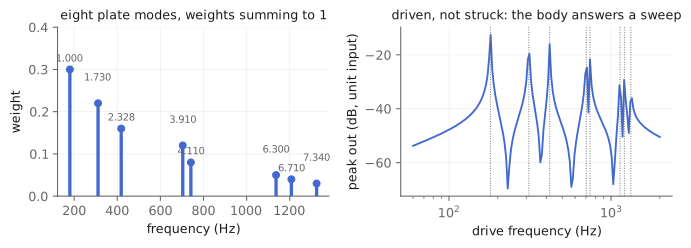
Left: where the modes are. Right: the body answering a sweep, which is how you actually meet it.
pitch places the lowest mode and the rest follow. decay is the
fundamental's T60 — long is a drone, short is a plate reverb. tilt decides
how much faster the upper modes die than the fundamental, and brightness
weights them. The weights sum to exactly 1 and each mode has unit peak gain,
which is why there is no limiter on the output and no DC blocker either: the
body is bounded by its input, by construction.
The palme
Twelve strings, each a damped delay loop, on one board.
Twelve, not twenty-four. Widely copied build pages say two banks of twelve; the peer-reviewed source says twelve, and this object follows the peer-reviewed source.
Their tuning is not published anywhere found, so it is a control: @tuning 0 lays them out chromatically across an octave from root — a string for
every pitch class, so the board answers whatever you play — and @tuning 1
puts the harmonic series on the root, which is a drone that answers one key.
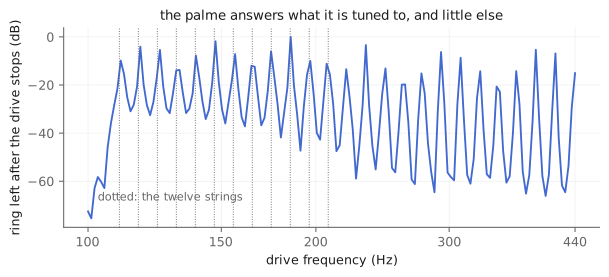
Feed it a tone, take the tone away, measure what is left. Every one of the twelve strings rings at least 4.4× harder at its own pitch than between them.
damping is how fast a string loses its upper partials — low values are
felt cloth on the strings. detune scatters the strings against each other
by a fixed, deterministic amount in cents, because no two strings on a real
board are in perfect relation.
The transducer
Wijnand et al.'s point about the early diffuseurs is that they use a moving-iron driver whose operating principle is inherently nonlinear — Thiele–Small does not describe it — so a diffuseur modelled as a pure resonator is missing a documented stage.
What is modelled here is that principle, not a fit to a measurement. In a
moving-iron motor the force follows the square of the gap flux, so with a
bias current I₀ and signal i the force carries a term in (I₀ + i)²
whose residual i² makes second-harmonic distortion that grows with drive.
That is asymmetry: the transducer's own even-harmonic signature, and the
only part of these objects that is nonlinear by citation.
saturation is the honest exception. A squared law is expansive and
something has to bound it, so there is a soft clipper after it — a
modelling necessity, not a measured stage, and its coefficient is a knob
rather than a number from a paper. At 0 it is exactly linear.
What these are, and are not
The instruments, their dates, their excitation and their transducer type are peer-reviewed. The modal data is not. No ondes-specific measurement of either body exists in any source obtained, so the plate comes from Fletcher & Rossing's free circular plate and the strings from the harmonic series. Both bodies are therefore recreations of the general physics, not models of Martenot's instruments. Nothing here was fitted to a recording, a measurement, or a photograph.
There is also no radiation model — no directivity, no cabinet, no soundboard
resonance of its own. The output is the body's modal response, not a room.
And the strings are ideal: a real steel string is stiff and its partials
stretch sharp, and that dispersion is not modelled. detune scatters
strings against each other, which is a different thing and does not stand in
for it.
Recipes
- A guitar into the palme:
tap.palme~ @root 110 @tuning 0 @decay 8 @mix 45. The halo underneath everything you play. The reason these ship standalone. - The instrument, assembled:
tap.ondes~→tap.palme~ @mix 60. What Martenot actually had. - Gong reverb:
tap.metallique~ @pitch 180 @decay 1.5 @tilt 1.2 @mix 35. Short decay turns the body into a plate. - A drone you drive:
tap.metallique~ @decay 20 @drive 3 @asymmetry 0.5 @saturation 0.4 @mix 100. Hard into the transducer, which is upstream, so it is a distorted waveform ringing a gong rather than a distorted gong. - The one to be careful with:
tap.palme~ @level— twelve resonant loops add up, and a driven board can be much louder than what went into it.
When it is not the right tool
- A reverb. These are twelve strings and eight modes. They are pitched, and they will impose their pitches on anything you send.
- A model of Martenot's own diffuseurs. See above: this is the physics of the general case, and the difference is stated rather than glossed.
- Clean sustain.
tap.5comb~is the sustained-resonance object without a nonlinear driver in front of it.
Checkpoint
Two loudspeakers with bodies, shipped as effects because a resonating cabinet does not care what drives it. Driven rather than struck, so no trigger and no envelope. The transducer is upstream of the body and a bitwise null test pins that it is — 28 % of peak says the order is audible. Every mode has unit peak gain and the weights sum to 1, so the body needs no limiter. And the bodies are recreations of published physics rather than measurements of Martenot's instruments, which is a limitation stated here and in the header rather than left to be discovered.