One network, eight voices: the tr808_* headers
Roland built an entire drum machine out of about four circuit ideas, so the kernel does too: a bridged-T resonator class, a six-oscillator metal bank, a noise/VCA toolkit, and eight thin per-voice headers that compose them. This appendix covers the shared blocks' math — the bridged-T's trapezoidal solve and why the bass drum needs it solved that way, the metal bank's tolerance model — and the per-voice compositions, ending with the calibration pass that re-fit the family's envelopes against a real unit.
Provenance: the Werner–Abel–Smith papers (the DAFx-14 bass-drum analysis
and the cymbal/cowbell companions) and the TR-808 Service Notes, read
component by component. Every constant in these headers carries a schematic
designator or a paper section; the calibration numbers live in
tr808_calibration.ipynb.
bridged_t.h: the universal voice circuit
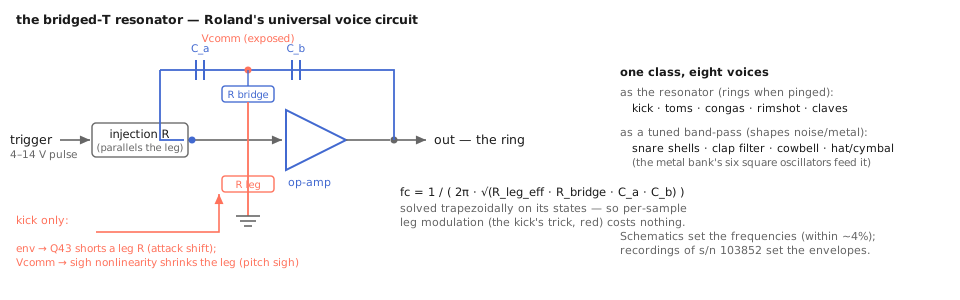
The network every voice reuses, with the kick's circuit-bending drawn in red.
An op-amp with a bridged-T network in its feedback path — capacitive arms
C_a, C_b, a resistive bridge, a resistive leg to ground — rings when
kicked, as a decaying pseudo-sinusoid at
fc = 1 / ( 2π · sqrt(R_leg_eff · R_bridge · C_a · C_b) )
where R_leg_eff is the leg in parallel with every resistive injection
into the center node. Roland used this network in every voice: as the
resonator of the kick, snare, toms/congas, rimshot, and claves, and as the
band-pass of the clap, cowbell, cymbal, and hats. One class, one family.
Two implementation decisions matter:
- The topology is reproduced, not summarized. With injections grounded,
the class's transfer function matches the DAFx-14 paper's printed
Eqn. (5) coefficient by coefficient (β₂ = α₂ = R_eff·R167·C41·C42, and so
on); the injected paths match their Hbt2/Hbt3, interchanged by injection
resistor; and the center node the paper calls
Vcommis exposed, because the bass drum's pitch-sigh nonlinearity reads it. The whole thing was re-derived by nodal analysis and pinned by unit test — the paper is trusted, then verified. - Trapezoidal on the states, not bilinear on the coefficients. The
discretization uses capacitor companion models — a 2×2 linear solve per
sample — which is algebraically the bilinear transform the paper uses,
but solved on the network states directly. The reason is the bass drum:
its leg resistance is modulated per sample (the attack shift shorts a
resistor through Q43; the pitch sigh shrinks the effective leg through a
fitted nonlinearity). With a coefficient-form biquad that would mean a
full redesign every sample; with the companion-model solve, a
time-varying resistor is just a changed matrix entry. Same ZDF family as
the house
svf.h.
The kick, since it exercises everything
tr808_kick.h composes the resonator with the paper's full block diagram:
pulse shaper → retrigger network → bridged-T with a feedback buffer closing
a regeneration loop → tone → level. The three signature behaviors are all
emergent from the modeled schematic: for ~6 ms the envelope saturates Q43
and the ring sits near ~129 Hz (the attack punch); as the envelope
collapses, C39/R161/D52 kick the center node again (the retrigger, so the
note doesn't step down); and leakage lifts Q43's base when the center node
swings below a diode drop — the paper's fitted memoryless nonlinearity
(α = 14.315, V₀ = −0.556, m = 1.4765e-5) converts Vcomm to a collector
current that shrinks the leg, so big early swings ring sharp and relax down
as the note decays. That is the sigh, and it is a different mechanism
from the attack jump — the paper's central untangling, preserved here. One
erratum survives in the header: the paper's Eqn. (9) as printed is garbled,
so the leg formula was re-derived from KCL at Q43's collector and matches
their stated limits.
Accent is the trigger voltage — 4–14 V on the bus, mapped from the 0..1 edge amplitude — exciting the network harder, not scaling the output. And filter states persist across triggers, so rolls interfere with the ringing tail: no machine-gun effect, by construction rather than by crossfade.
swing_vca.h: the small shared parts
The 808 shapes its percussive gains with one-transistor "swing type" VCAs
driven by RC discharges, not ADSRs. The header holds the three primitives
the noise voices share: decay_env (one-pole rise to a level, exponential
decay — retriggering re-aims the rise, no reset click), the linear
swing_vca gain (the hardware's "many high harmonics" are a flagged
refinement), and white_noise — a seeded xorshift64*, because the 808 has
exactly one noise generator feeding the snare's snappy, the clap, the
maracas, and the toms' noise layer, and because determinism-per-seed is a
house invariant: renders reproduce, tests pin, mc. instances decorrelate.
metal_bank.h: six squares and a spread
The metallic voices all draw on one bank of six Schmitt-trigger relaxation oscillators: nominal 205.3, 369.6, 304.4, 522.7 Hz plus the two trimmer-tuned at 800 and 540 (the pair the cowbell taps), duty 47.98 % per the paper's HD14584 analysis. Three modeling calls:
- Naive squares are faithful. The fundamentals sit below 1.2 kHz and the hash above them is immediately band-passed; the residual aliasing folds into the same inharmonic wash the circuit itself produces. PolyBLEP would be cost without benefit — a rare sentence in this repo, so it's documented.
- Tolerance is part of the instrument. The RC parts put any given
unit's oscillators up to ~20 % off nominal — the paper's measurement, and
the reason no two 808s' cymbals sound alike.
tolerancescales a deterministic per-seed spread of exactly that width. This is not "analog warmth" seasoning; it is a measured production statistic. - The two band-pass voicings (~3440 and ~7100 Hz, Q fit to the paper's published skirts) and the Q19 attack smoother (τ = 102.44 µs less a 0.7258 V base-emitter drop, their least-squares fit) live here too, because cymbal, hats, and cowbell all share them.
The voices, as compositions
Each tr808_*.h is a thin arrangement of the blocks above, with its own
schematic constants:
- Snare: two bridged-Ts at the late-revision ~173/336 Hz (the design
change is documented in the header), a trigger divider, and the snappy
path —
decay_env-shaped noise, band-limited near 4 kHz. - Clap (
clap|maracas): ~2 kHz dual band-pass noise through a VCA driven by the Service Notes' Figure-13 three-teeth sawtooth — the "multiple hands" transient — plus the Q70 reverberation tail. - Hats: one circuit, two envelope paths, and the hardware choke
(Q23/R173): a closed-hat trigger terminates a sounding open hat, pinned
by test. This is why
tap.808.hat~is one object with two inlets — the choke is unimplementable across separate externals. - Cymbal: the bank through both voicings with two separately enveloped bands (strike/ring/body), decay spanning the chart's 350–1200 ms.
- Cowbell: just the 540/800 pair into the ~860 Hz voicing, two-slope envelope.
- Toms/congas (
@size×@model): the resonator at the chart tunings with the D80/D81 attack pitch fall; toms add a pink-noise layer (pinned by seed-sensitivity, since the diode bend's own harmonics defeat spectral separation); congas are the same circuit, no noise. - Rim/claves: the ~1667 + 455 Hz crack with the swing-VCA's tanh harmonics, versus the pure ~2500 Hz tick.
The family also carries per-channel summing gains (k_tomc_mix,
k_cl_mix — the hardware's summing resistors into the mix bus): the
bridged-T's impulse gain grows with fc·Q, and before the balance pass the
high conga peaked at ~5.3 while other voices sat far lower. Every voice's
full-accent peak now lands in a consistent ~0.3–1.0 band, pinned by test.
The calibration pass: what measurement actually changed
The family was calibrated against a real unit (s/n 103852) recorded from the individual outs with knob positions encoded in the filenames — a 0/2.5/5/7.5/10 dial grid, 116 samples — so the comparison ran per knob cell, with identical measurements (spectral-peak fundamental, −40 dB decay, power centroid) on both sides. The result is a clean split:
- Frequencies: the schematics were right. Kick within 2.4 %, snare within 1.2 % (including the tone-max mode flip), toms/congas/cowbell/ claves within ~4 %. The kick needed no constant changed.
- Time: the recordings won. Tom, conga, cowbell, and clap tails roughly doubled; the snappy was band-limited and re-enveloped; the rimshot re-voiced low-dominant; the cymbal's decay span and brightness corrected; the closed hat's brightness residual later resolved by the hats' sizzle blend.
Each header carries its calibration note with numbers and residuals. The lesson is worth stating as a rule: schematics get you the frequencies; recordings get you the envelopes — decay behavior hides in pot tapers, electrolytic tolerances, and aging that no schematic states.
The engineering ledger
- One resonator class vs. per-voice filters. Eight voices reduce to ~4 blocks plus thin compositions only because the bridged-T class keeps the injected-path structure of the real network instead of collapsing to a generic biquad. The generality was free once the nodal analysis was done — and the kick's per-sample leg modulation required it.
- Behavioral envelope generators. The kick's EG is modeled as fast rise / ~1.1 ms release rather than as its own transistor network — the paper's own simplification, adopted with its citation. Fidelity effort went where the analysis said it matters (the leg, the retrigger, the sigh), not uniformly everywhere.
- The WDF door, left closed but unlocked. The flagged
@circuitupgrade path (wave digital, thesvf.htwo-circuit pattern) remains gated on an A/B showing an audible delta the informed model misses. The DAFx-14 paper's own finding — device nonlinearity matters less than folklore claims — suggests the gate may never open, which would itself be a documented result. - Determinism everywhere. Seeded noise and seeded tolerance mean every render, test, and calibration measurement is reproducible bit-for-bit. The calibration pass would have been guesswork without it.
Checkpoint
One network class matching the published transfer functions exactly and solved on its states so a time-varying resistor costs nothing; a metal bank whose ±20 % spread is a measurement, not a vibe; voices that are thin compositions with schematic-designated constants; and a per-knob-cell calibration pass that confirmed the frequencies, corrected the envelopes, and wrote its residuals into the headers it changed. Four ideas, eight voices, every number traceable.