Convolution without compromise: conv_engine.h
The user-facing chapter (Borrowed rooms) made a flat claim:
tap.convolve~ is exact — not "high quality," exact — and its only cost
is a latency of precisely blocksize samples. Claims like that are either
algebra or advertising. This appendix does the algebra: why the convolution
is partitioned at all, why overlap-save, why the latency is exactly one
partition, and how an impulse response can be replaced mid-performance
without the audio thread ever seeing a torn table.
Why partitioned: the cost triangle
Direct convolution of a stereo pair against an L-second IR at rate fs costs
cost_direct = L·fs MACs per output sample per path
— 48 000 multiply-adds per sample for one second of room at 48 kHz, times four paths for true stereo. Untenable. The classical fix is to convolve in the frequency domain: transform the whole IR once, multiply spectra, invert. But a single-FFT scheme cannot emit anything until it holds a full frame of input, so its latency equals the IR length — seconds of delay for a reverb. Also untenable.
Uniform partitioning takes the middle of the triangle. Split the IR into P
equal partitions of B samples, h_j[k] = h[j·B + k]; then by linearity
h = Σ_j h_j delayed by j·B
Each partition is short enough that its convolution can be computed with a
small FFT once per B-sample block, and the delays j·B are whole blocks —
which, we will see, cost nothing but indexing. FFT economics, latency of one
partition. This is the standard engine of the genre for a reason.
Overlap-save: the framing, derived
The engine convolves each partition by circular convolution over an FFT of
size m_fftsize = 2·m_block — size 2B for partition size B. Circular and
linear convolution are not the same thing; the design question is which
output samples of the circular product are also the linear ones.
Take the frame the code actually builds in process_block():
frame_m = [ block_{m−1} ; block_m ] (m_fre[j] = m_prev[ch][j]; m_fre[B+j] = m_inblk[ch][j])
and a partition h zero-padded from B to 2B. The circular convolution is
y_circ[n] = Σ_{k=0}^{B−1} h[k] · frame[(n − k) mod 2B]
For n in the second half, n ∈ [B, 2B), and k < B, the index n − k stays
in [1, 2B): the mod never wraps, so y_circ[n] equals the linear
convolution of h with the input stream at that time. For n < B the mod does
wrap, splicing in samples from the frame's far end — time aliasing. So each
2B-point product yields exactly B valid samples, the second half, and the
code keeps precisely those:
m_outblk[oc][j] = m_are[m_block + j]; // overlap-save: discard the aliased first half
That is the whole scheme: hop by B, keep the clean half, discard the dirty
half. The alternative, overlap-add, zero-pads each input block instead and
sums overlapping output tails — equally exact in theory, but it carries a
partial-sum accumulation buffer across block boundaries, one more piece of
state to get right. Overlap-save's output block is finished the moment the
IFFT returns: no summation state, no output windowing, no crossfading —
there is nothing between the IFFT and the output buffer that could be
inexact. Every step in the chain — framing (a copy), FFT and IFFT (the
shared radix-2 in fft.h, whose inverse divides by N so a round trip
reconstructs its input), and the multiply-accumulate — is exact linear
algebra in double precision. The engine has no tuning parameters that trade
accuracy for speed; its error budget is rounding noise, and the measurements
below confirm that is all there is.
The frequency-domain delay line
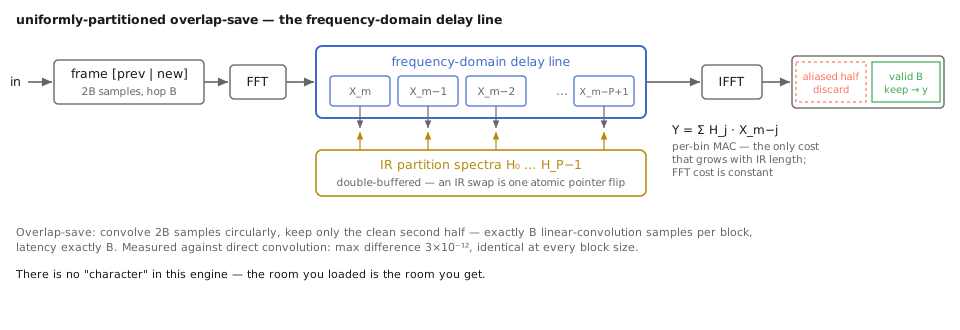
Why FFT cost is constant in IR length: the transforms bracket the structure, and only the MAC sees the partitions.
The delays j·B remain. Delaying partition j's contribution by j blocks is
the same as convolving it with the input from j blocks ago — and the frame
for block m − j has already been transformed. So the engine keeps a ring of
past input spectra (the FDL, m_fdl_re/m_fdl_im, one per input channel)
and forms the output spectrum as
Y_m[k] = Σ_{j=0}^{P−1} H_j[k] · X_{m−j}[k]
which is exactly the inner loop: slot = cur − p (mod m_max_parts), then
a complex multiply-accumulate over all m_fftsize bins into
m_are/m_aim. The consequence for cost is the design's payoff: one
forward FFT per input channel and one inverse FFT per output channel per
block, regardless of P. Growing the IR grows only the MAC. Per output
sample, the MAC costs P·2B complex MACs / B samples = 2P complex MACs ≈ 8P
real multiplies per path, versus P·B real MACs for direct convolution — a
factor of B/8 (64× at B = 512), with the FFTs an O(log B) constant on top.
Latency is exactly B, by the framing
Follow one sample through process(): it is written into m_inblk at
position m_pos, and the output handed back at that same call is read
from m_outblk[m_pos] — a block computed when the previous block
completed. When block m finishes, process_block() runs with a frame ending
at the newest sample, and its B valid outputs are the linear convolution up
to that sample; they are then dealt out during block m + 1. So output sample
t carries y(t − B): the first partition's contribution to a block is
computed from the block just gathered, not from anything older, and the
delay is one partition — no more (the frame includes the newest sample) and
no less (nothing can be emitted before a block is complete). The unit test
pins both edges: the first B output samples are silence (the pre-roll), and
an IR of δ at index 5 yields the input delayed by exactly B + 5. The
notebook verified the latency at B = 64, 256, and 1024 — always exactly B.
Exact, measured
The notebook (executing the real engine through the C ABI) puts numbers on "exact": against a direct time-domain convolution of the same IR — 24 000 samples, B = 512, 47 partitions — the maximum difference is 3.13×10⁻¹². Across block sizes the outputs agree with the direct reference to 2.27×10⁻¹³ / 1.17×10⁻¹² / 1.76×10⁻¹² (B = 64/256/1024), and with each other, latency-removed, to 1.81×10⁻¹² — the block size is a CPU/latency dial with no audible existence. An impulse through the engine reconstructs the loaded IR to 5.5×10⁻¹⁴, and a synthetic 0.60 s-RT60 reverb measures back at 0.599 s. The unit test does the same job in CI with independent per-path IRs, deliberately awkward 10-sample process chunks that straddle block boundaries, and 10⁻⁹ tolerances.
True stereo: four paths, two FFTs
A stereo room is a 2×2 linear system, and the engine runs all of it:
out_l = in_l ∗ h_LL + in_r ∗ h_RL ; out_r = in_l ∗ h_LR + in_r ∗ h_RR
with path = in_channel·2 + out_channel (0 = LL, 1 = LR, 2 = RL, 3 = RR).
The economics are better than 4× mono: the two input FFTs are shared across
all four paths, and each output channel needs one inverse — so a block costs
2 forward FFTs, 2 inverse FFTs, and 4 MAC passes. The notebook pins the
routing: an impulse into L only emerges on R at exactly the cross-feed
path's gain (0.600 expected, 0.600 measured) and, with the off-diagonal
paths silent, R stays at 0.0 — cross-terms cannot hide in each other. The
mapping from buffer~ channel count to paths (4+ = true stereo, 2 = dual
mono, 1 = same room both sides) is wrapper policy; the engine only ever
knows four pointers, any of which may be null for a silent path.
The atomic IR swap
Loading a room while the music plays is the one place this engine touches
concurrency, and it is confined to a single atomic. The IR tables are
double-buffered per path (m_ir_re[path][slot], slots 0/1). load_ir() —
which runs off the audio thread; it is the expensive part, P analysis FFTs
per path — writes only the inactive slot, then publishes:
m_slot_parts[inactive] = P;                          // written before the publish...
m_active.store(inactive, std::memory_order_release); // ...so (slot, P) stay consistent.
The perform loop does one acquire load of m_active per block. The
release/acquire pair means that if the audio thread observes the new slot
index, it also observes that slot's fully written spectra and its
partition count — slot and P travel through one atomic, so there is no
window where the loop MACs over half-written tables or over the wrong
number of partitions. Until the store, the loop reads the old slot, which
the loader never touches. The discipline is single-writer double-buffering:
publishes are serialized through the wrapper's message path, and the just
vacated slot is only rewritten by the next load.
Why does a swap settle in exactly one block? Because the FDL stores input
spectra, not output. The first process_block() after the publish already
renders the entire tail — all P partitions — from the new IR against the
existing input history; the only samples that differ from a
new-IR-from-the-start engine are the ones sitting in m_outblk, computed
just before the swap. The unit test pins the settling (output equals the new
IR's pure delay from shortly after the swap); the notebook pins it exactly:
max |swapped − reference| after +1 block = 0.00×10⁰ — bit-identical to
an engine that had the new IR from the start — with RMS continuity across
the swap instant, 21.922 before, 22.147 just after, no dropout. Honest
limit: the swap is a hard splice between two exact convolutions, click-free
but discrete; the engine does not interpolate between rooms.
A related freebie of the input-side FDL: analysis of incoming audio happens before the has-IR check, so the delay line is warm even while no IR is loaded — load the first room mid-stream and its tail renders immediately from audio already played.
The engineering ledger
- Uniform, not Gardner non-uniform, partitioning. Non-uniform schemes (short partitions first, growing later) can push latency below B for the same CPU, but they need multiple FFT sizes and a scheduler that spreads long-partition work across blocks — real complexity with real failure modes. The object's latency budget is satisfied by making B small (64 samples = 1.3 ms, verified exact above); complexity was not bought that nothing needed.
- The shared FFT.
fft.his the in-house radix-2 Cooley–Tukey used by the whole spectral set; per its header it lived byte-identical insideconv_engine,tap.nr~, andtap.spectra~before being consolidated at the kernel split. In-place, forward unscaled, inverse divides by N — round-trip exact by construction. No external FFT dependency, per the porting philosophy. - IR stored as float32, deliberately. A
buffer~holds 32-bit samples; the engine quantizes atload_ir(static_cast<double>(src[idx]) * scale) and computes in doubles thereafter. The notebook's direct-convolution reference casts its IR through float32 the same way — so the 10⁻¹² figures isolate the algorithm, not the source quantization the wrapper inherits from Max regardless. - Geometry only in
configure(). Partition size and capacity determine every buffer, so reallocation happens only where the audio thread is idle — the wrapper calls it fromdspsetup.clear()flushes running state withstd::fillonly, no reallocation, and is safe from a message handler;process()allocates nothing, ever (scratch spectram_fre/m_fim/m_are/m_aimare preallocated and reused). - Capacity vs. length. The FDL ring is sized
m_max_parts; a loaded IR usesP ≤ m_max_partspartitions (load_irclamps), and the MAC runs over P only — a short room in a big engine costs a short room. - The deferred optimization, on the record. The spectra are stored and MAC'd full-complex; the input is real, so a half-spectrum (N/2 + 1 bins, Hermitian symmetry) form would halve both the MAC and the IR/FDL memory. The header flags it and parks it, under the same house rule the SVF appendix recorded: optimizations land bit-identical or explicitly signed off — and re-deriving the packing arithmetic is exactly the kind of change that gets signed off with a measurement, not slipped in.
Checkpoint
Partitioning splits the IR by linearity; overlap-save framing makes each 2B-point circular product yield B exactly-linear samples with nothing to window or crossfade; the frequency-domain delay line turns partition delays into ring indexing, so FFT cost is constant in IR length and only the MAC grows. Latency is one partition by the framing — measured at exactly B for every B tried — and exactness is measured at 10⁻¹²-and-below everywhere it can be probed. The one concurrent act, swapping rooms, rides a single release/acquire atomic over double-buffered tables, and settles bit-identically in one block because the delay line remembers input, not output. The compromises the genre usually accepts — approximate tails, block-size coloration, swap dropouts — are absent, and the measurements say so.