The oscillator and its knobs
Play a perfectly calculated sawtooth for ten seconds and you will learn
something uncomfortable: perfection sounds like a diagram. Every cycle
identical, every harmonic exactly where the textbook puts it, nothing moving —
the ear files it under test tone and stops listening. Now play three of them,
each a few cents off the others and each wandering a little, into a filter that
pushes back — and the same arithmetic becomes a synthesizer. This chapter is
about tap.vco~: what it generates, what each attribute trades, and how to get
from the diagram to the instrument — including the honest version of the Moog
recipe.
Companion material: the object's reference page (docs/tap.vco~.maxref.xml)
and help patcher (help/tap.vco~.maxhelp in the TapTools-Max package) wire up
every control in this chapter; the
verification notebook
shows every number quoted here as an executed, plotted measurement.
One phase, four shapes, no aliasing panic
Inside the object there is a single master phase ramping from 0 to 1 at the
frequency you asked for. Everything else is a way of reading that phase: a
sine reads it through sin, a saw stretches it to ±1, a pulse compares it to
the pulse width, and the triangle integrates the pulse (the classic analog
trick, reproduced digitally because it behaves so well). The continuous shape
parameter (0 sine → 1 triangle → 2 saw → 3 pulse) crossfades adjacent readings
of the same phase, so a shape sweep glides through hybrid waveforms without
resetting anything.
The digital oscillator's ancient enemy is aliasing: a naive saw's harmonics
march past Nyquist and fold back as inharmonic garbage. tap.vco~ suppresses
this with polyBLEP — each waveform discontinuity is rounded across ±1 sample by
a polynomial that closely matches what a band-limited step would do. Measured
against a naive saw at 3951 Hz (a B7, ugly on purpose): the 13th harmonic folds
back to 3.4 kHz, where the naive saw puts it at −27 dB and tap.vco~ puts it at
−74 dB — 47 dB of alias suppression right where the ear is most offended.
Two things about this are worth knowing so they don't surprise you:
- The waveforms look "not band-limited" on a scope. Expected. The BLEP correction touches two samples per edge — at 440 Hz that's 2 of ~109 samples per cycle — and there is none of the Gibbs ripple that brickwall band-limited waves show, because nothing is truncated. The shape stays essentially ideal; the spectrum is what's controlled.
- Alias suppression is not alias elimination. Push the fundamental into the kilohertz range and distant fold-backs remain, tens of dB down. For melodic and bass registers they are simply gone.
The wiring
   frequency (signal or float)     FM, in Hz (signal)     sync (signal)
              |                          |                     |
        +-----+--------------------------+---------------------+-----+
        |                       tap.vco~                              |
        +-----------------------------+-------------------------------+
                                      |
                              (signal) the waveform
- Inlet 1 sets the frequency — a float sets the attribute, a signal drives it with true per-sample resolution.
- Inlet 2 is through-zero linear FM, calibrated in Hz: the input adds directly to the effective frequency. Drive it past the carrier and the phase genuinely runs backward (that's the "through zero" — the classic DX-style sideband sound stays coherent instead of collapsing). Measured: a 500 Hz sine carrier under ±900 Hz of FM stays bounded at exactly 1.0 peak and puts its sidebands where the textbook says.
- Inlet 3 is hard sync: every rising zero crossing of the input resets the phase, with sub-sample accuracy and an alias correction on the reset. Measured: a 187 Hz slave synced to a 110 Hz master emerges periodic at 110.1 Hz — the pitch follows the master, the timbre follows the slave's frequency, which is the whole trick of sync sweeps.
Single-channel, like every TapTools DSP object: wrap it in mc. for stacks,
and keep reading, because the analog section was designed around exactly that.
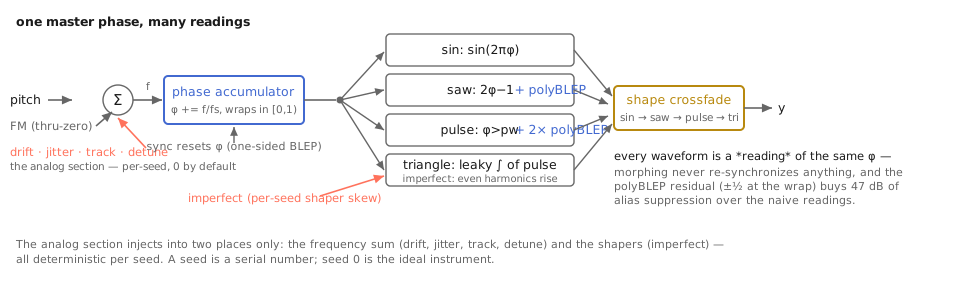
One phase, many readings — with polyBLEP correcting the edges and the analog section injecting in exactly two places.
The knobs, one by one
frequency, and gliding
Hz, from LFO rates (0.01 Hz) to 20 kHz. Every parameter in the object rides a
per-sample ramp whose length is the smooth attribute (ms, default 20) — and
on frequency that ramp is portamento. Set smooth to 60–100 ms, send note
frequencies as floats, and you have the Minimoog glide, no extra objects. For
stepped pitch, set smooth low; for per-sample modulation, use the signal
inlet (which bypasses smoothing entirely — you are the smoothing).
shape and waveform
shape is the continuous morph; the waveform sine|triangle|saw|pulse message
snaps it to a corner. The corners are the pure shapes; everything between is a
crossfade of neighbors on the shared phase. Slow shape sweeps are an
underrated modulation destination — the morph is click-free by construction
(measured: a 2-second sweep from 0 to 3 keeps its RMS within a factor of ~5 and
never drops out).
pw — pulse width
Percent, 1–99, audible as shape approaches 3. The calibration is exact: a
bipolar pulse at duty d must average 2d−1, and the measured means at 10/25/50 %
are −0.800/−0.500/+0.000. PWM by an LFO into pw (via messages, riding the
smooth ramp) is the cheapest "two oscillators" impression one oscillator can
give.
gain, presets, interp
gain is output level in dB. Sixteen preset slots store every parameter
(store 1 … store 16), and recall morphs to a slot over interp
milliseconds (or an explicit time: recall 3 4000) — every parameter riding
its ramp simultaneously, shape included. A preset morph across two very
different voicings is a patch element in its own right.
seed — which unit you own
Everything random in this oscillator — the drift walk, the jitter noise, and
(below) the component tolerances — is generated deterministically from seed.
Same seed, same render, bit for bit: your mixes reproduce and the test suite
can pin behavior exactly. Different seeds decorrelate. The mental model that
pays off: a seed is a serial number. One tap.vco~ with seed 7 is a
particular oscillator that came off the line; seed 8 is the unit next to it in
the crate. An mc. stack with per-voice seeds is a set of instruments, not
copies of one.
The analog section
Here is why a hardware oscillator sounds alive, reduced to what a DSP model can honestly act on. A real VCO is unstable at two time scales — it wanders over seconds (thermal drift) and trembles over milliseconds (noise in the core) — it is mis-calibrated in a structured way (the V/oct converter is exact at its trim point and increasingly wrong away from it), and its waveforms carry the circuit's fingerprints (a bowed ramp, a rounded reset corner, a duty cycle that isn't quite 50 %). None of these is large. All of them are always present, all slightly different from unit to unit, and the ear reads their sum as alive long before it can name any of them.
tap.vco~ models each one with its own control, all in real units, all
deterministic per seed, and all exactly zero by default — the default
object is the ideal oscillator, and the kernel's test suite pins that at
imperfect 0 every seed renders bit-identically.
drift — the slow wander (cents)
A random walk: sample-and-hold noise at ~2 Hz smoothed through a ~0.5 Hz one-pole, scaled to the depth you set. This is the thermal story — the pitch center strolling around over seconds. In a unison stack it is the difference between "chorus effect" and "three players": chorus modulation is periodic and shared; drift is aperiodic and per-voice. Ranges: 3–8 cents reads as a well-serviced vintage instrument; 15–25 as a charming one; 50+ as a broken one.
jitter — the fast tremble (cents)
New with this chapter: the short-time companion — noise at ~80 Hz through a ~40 Hz smoother, so the pitch trembles cycle-to-cycle instead of strolling. Measured at 10 cents depth: the relative spread of individual periods is 2.7×10⁻³ (a few cents, exactly as labeled), against 2×10⁻⁷ for the ideal oscillator — four orders of magnitude more micro-instability, still nothing like vibrato. This is the control that stops a sustained single oscillator from sounding frozen. Ranges: 1–4 cents is felt more than heard; 8–15 is audible grit on pure waveforms.
detune and track — the calibration story (cents, cents/octave)
detune is the static offset — the coarse fact that oscillator 2 was never
exactly oscillator 1. track is subtler and very analog: cents of error per
octave from A440, the exponential converter drifting from its trim point.
Measured with track 5: exactly 0.0 cents at A440, +15.0 cents three octaves
up, −15.0 three octaves down, a clean line through the middle. Solo it is
nearly invisible; in a stack played across the keyboard it is why vintage
unisons get wider — and slightly wilder — up the neck. Ranges: real
serviced hardware tracks within 1–3 cents/octave; ±5 is a synth that needs its
yearly appointment.
imperfect — the circuit's fingerprints (0..1)
One knob for the waveform-shape story, scaled by per-seed component tolerances so each seed misbehaves in its own direction:
- the saw ramp bows into the familiar shark-fin (a visible, scope-obvious shape change; spectrally it is mostly a phase effect — stated here so you don't chase magnitude changes that aren't there),
- the saw's reset corner rounds off: a gentle one-pole closing from ~22 kHz toward ~8 kHz — measured 6.4 dB down at the 40th harmonic (17.6 kHz) at full imperfection; extreme top-end air, traded for warmth,
- the triangle goes asymmetric, and this one is very audible in the spectrum:
the ideal triangle's 2nd harmonic sits at −185 dB (i.e., absent); at
imperfect 0.8it rises to −34 dB relative to the fundamental — even harmonics, the classic "warm" giveaway, - the sine picks up mild waveshaper color, and the pulse width takes a small static offset (so two "50 %" pulses from two seeds beat against each other the way two real units do),
- the whole unit takes a static pitch offset of up to a couple of cents.
Ranges: 0.2–0.4 is a healthy vintage unit; 0.6–0.8 is character you can point to in a mix; 1.0 is a unit with a story. At 0, every seed is the same ideal machine — the analog section never costs you the reference oscillator.
The performance section
Where the analog section models what the circuit does on its own, these controls model what a hand does to it — added after the Recipes chapters had to teach a scaling formula to get constant-width vibrato out of the Hz-calibrated FM inlet.
vibrato/vibrato_rate— a sine LFO on the pitch, depth in cents (0–100) and rate in Hz, so ten cents is ten cents in every register. Measured: at a commanded ±100 cents the peak cycle-to-cycle deviation reads 90–110 cents, and the modulation crosses its mean at exactly twice the commanded rate (pinned by test).vibrato_delay— the singing control: the vibrato fades in through a one-pole with this time constant (ms), re-armed on every new note (every frequency-target change), so held notes bloom and passing notes stay plain. Pinned: early deviation under 60 % of settled, and shallow again right after a note change. The signal-rate frequency inlet deliberately does not re-arm — there, you are the modulation.bend— pitch bend in semitones (±24), riding the standardsmoothramp: the wheel, as an attribute. Pinned within 5 cents of the commanded interval.
All of it is deterministic with no randomness — and at depth 0 the output is bit-identical to the ideal oscillator (pinned), so the reference instrument is still free.
The Moog recipe, honestly
The sound everyone wants from this object is three oscillators into a ladder. Here is the recipe, with the honest accounting of which ingredient does what. Rendered A/B demos of exactly this patch (through the real kernels) live in the notebook material.
| voice | frequency | detune | drift | seed |
|---|---|---|---|---|
| 1 | f | −4 c | 8 c | 11 |
| 2 | f | +5 c | 8 c | 22 |
| 3 | f ÷ 2 | +2 c | 10 c | 33 |
- All three:
@shape 2(saw),@smooth 70for glide,@jitter 3,@track 2,@imperfect 0.3. - Sum them (scale by ~1/2.8) and feed
tap.ladder~:@mode lp24 @resonance 0.35 @drive 9 @asym 0.45 @comp 0.25.
What each ingredient buys, in order of importance:
- The stack itself. Three free-running voices at ±cents is most of the
sound. The beating between them is the fatness; the octave-down third voice
is the weight. (
tap.vco~free-runs like hardware — no per-note phase reset — so the beat pattern is different on every note. That, not any single voice's tone, is the big analog tell.) - The ladder.
driveinto the tanh stages compresses and colors the stack;asymadds the even harmonics of mismatched transistors;compkept low preserves the authentic passband droop as resonance rises. A perfect saw into a driven asymmetric ladder sounds more "Moog" than an imperfect saw into a clean one — spend your character budget here first. - Glide. 60–100 ms of
smoothon the note changes. Iconic, and free. - The analog section. Drift keeps the beating from ever repeating; jitter un-freezes sustains; per-seed tolerances make the three voices three units. This is seasoning — essential in the way salt is, invisible in the way salt is.
Omit in reverse order when CPU or taste says so.
When it is not the right tool
- You need an exact test signal. Actually — it is the right tool:
imperfect 0(the default) is the mathematically ideal oscillator, and the test suite holds it there. Just don't reach for the analog section and a measurement mic in the same patch. - You want evolving spectra from one voice — wavetables, granular motion,
additive drift. This oscillator's spectrum is fixed per shape by design;
morph
shapeor FM it, but a wavetable oscillator is a different instrument. - You want chorus. Twenty cents of drift on one voice is not a chorus; it is a seasick oscillator. Chorus is a delay effect — use one.
- Noise. The bottom of the
shaperange is a sine, not a noise source;tap.noise~has five colors of the real thing.
Checkpoint
One master phase, four shapes and their hybrids, polyBLEP keeping the folded
harmonics ~47 dB down. Frequency glides on smooth, FM is in honest Hz and
survives through zero, sync locks pitch to the master while timbre stays yours.
The analog section is four controls with real units — slow drift, fast
jitter, structured mis-calibration in track, circuit fingerprints in
imperfect — all scaled by per-seed component tolerances, all exactly off by
default, all deterministic: a seed is a serial number. And the Moog recipe is
mostly the stack and the ladder — let the oscillator's imperfections season,
not carry.