The pedal that listens
A wah pedal is a filter with a foot attached. An auto-wah cuts out the
foot: it listens to how hard you play and sweeps the filter for you — hit a
string and the filter opens; let it ring and the filter settles back down.
tap.autowah~ models a specific, beloved instance of the idea: the Mad
Professor Snow White AutoWah, Björn Juhl's OTA-based envelope filter,
grounded in the traced circuit and the published behavior. This chapter is
how to drive it — and how we will know, measurably, when the model matches
the pedal.
Companion material: the reference page and help patcher in the TapTools-Max
package; the design document (plans/tap.autowah~.md in TapTools-Max) with
the full hardware research; and the
validation notebook,
which measures everything below and ends with a cell waiting for recordings
of the real pedal.
What the hardware is, in one paragraph
A 2-pole state-variable filter (an LM13700 OTA circuit) whose frequency is pushed up from a resting point by an envelope detector — a diode and a capacitor, charged fast, discharged at a rate you set. Four knobs: Sensitivity (how hard your signal drives the sweep), Decay (how fast it falls back), Bias (the resting frequency), Resonance (the Q). Published sweep: 250 Hz to about 2.5 kHz — a throaty, vocal range, deliberately unlike the quack of a Mu-Tron-style filter. One secret feature: with Sensitivity at minimum it becomes a fixed, manually swept filter — the "cocked wah."
The model composes tap.svf~'s Simper core (one 2nd-order section, driven
per sample — the modulation stability that filter chapter promised, cashed
in) behind a rectifier → attack/release follower and an exponential sweep
law. The measured control behavior:
- Sweep law: cutoff = bias · 2^(sweep · range). Measured against the design curve across the full envelope range: max error 0.000 cents. The law lives in one function on purpose — if the real pedal turns out to sweep linearly in Hz, one function changes and nothing else moves.
- Timing: attack set to 2 ms measures 1.94 ms; decay set to 250 ms measures 256 ms, and the release fits a pure exponential with residual σ = 0.004 — an RC discharge, like the hardware.
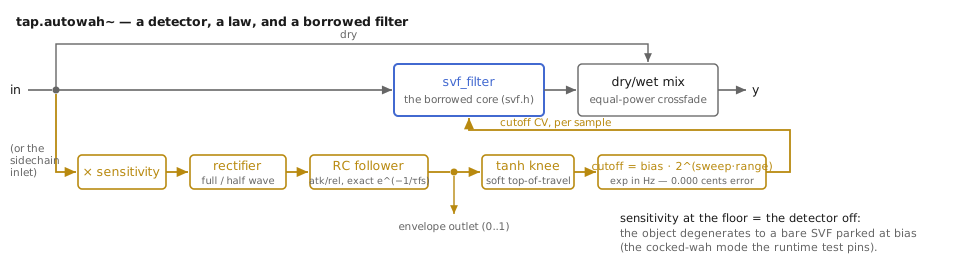
A detector, a law, and a borrowed filter — the amber chain is everything this object adds to the SVF it composes.
The knobs, one by one
sensitivity — the trigger level, and the secret mode
Detector input gain in dB (−60..+24). Tune it to your instrument and touch:
too low and only your hardest hits open the filter; too high and everything
pins at the ceiling (a tanh soft knee compresses hard playing into the top
rather than slamming a rail). At −60 the envelope is exactly off and the
object becomes the cocked wah: a fixed resonant filter with bias as the
manual sweep control. Factory preset 4 ships that voicing.
decay — the personality knob
How fast the filter falls back to bias, in ms (10..5000). Fast (tens of
ms) gives a wah articulation on every note — the funk setting. Slow
(hundreds of ms up) gives classic auto-wah swells that ride your phrasing.
This is the knob to perform.
bias and range — where the sweep lives
bias is the resting frequency (default 250 Hz, the hardware's home);
range is the sweep span in octaves above it (default 3.3, the hardware's
250 → ~2500 Hz). Both go far beyond the hardware if you want them to, and
direction 1 sweeps down from bias instead — a TapTools extension the
pedal never had.
resonance, mode, drive
resonance (0..1) is the Q — the vocalness. mode picks the filter tap:
lowpass is the stock voicing; bandpass is the circuit's other node, a known
hardware mod — quackier and noticeably quieter. drive (dB) engages the
saturating SVF circuit for OTA-flavored color; 0 keeps it pure.
attack, mix, and the rectifier
The hardware's attack is fast and fixed; ours defaults to the same 2 ms but
is exposed (0.05..100 ms) for softer onsets. mix is an equal-power dry/wet
the pedal never had — 100 % (wet-only) is the hardware. And under the hood
the detector's rectifier is selectable: full-wave (default, cleaner
tracking) or half-wave (the traced single-diode topology). Measured: the
half-wave detector carries 2.6 % signal-rate ripple on a low tone against
the full-wave's 0.7 % — a real, quantified flavor difference awaiting the
hardware A/B.
The sidechain inlet and the envelope outlet
A signal in the right inlet takes over the detector: one sound wahs another (a kick opening a pad is the classic). The right outlet emits the envelope (0..1) as a signal — the detector as a free modulation source for anything else in the patch.
Factory voicings
Preset slots 1–4 ship guitar, bass (lower bias, tighter range — the
GB pedal's instrument switch, as a preset you can morph to), slow swell,
and cocked wah. recall 2 4000 morphing from guitar to bass over four
seconds is its own effect.
How we'll know it matches
The validation harness is built and proven on ground truth. An STFT
peak-trajectory extractor recovers the swept resonant peak from wet audio
alone — no dry reference needed — and against the kernel's own cutoff trace
it correlates at 0.979 in log-frequency, with the small measured offset
(−37 cents) close to what resonant-peak physics predicts (−20 cents at that
Q). The same code runs on demo videos and on the real pedal. A Snow White is
on order; when it arrives, reamped recordings drop into
notebooks/reference/ and the notebook's last cell overlays hardware against
model. Disagreements map one-to-one onto kernel constants. That pass may flip
the default filter tap or the sweep law — both are flagged, isolated, and
waiting.
When it is not the right tool
- You want the filter on a knob or LFO, not your dynamics. That's
tap.svf~with a signal in its frequency inlet — this object's own core, without the detector. - Your source has no dynamics. A static pad through an auto-wah is a static filter. Feed the sidechain something rhythmic instead.
- You want the Mu-Tron quack. Different circuit, different voicing —
raise
resonance, trymode 1, but know you're modding a Snow White, not summoning a Mu-Tron.
Checkpoint
An envelope detector with a fast attack and a musician's decay knob, driving
a 2-pole resonant filter up from bias through an exponential law that
measures exact to the design. Sensitivity at the floor is the cocked wah;
the sidechain inlet and envelope outlet make the detector patchable; the
factory slots hold the four voicings that matter. And the model doesn't ask
to be trusted — the extractor that will judge it against the real pedal is
already built, already proven, and already waiting in the notebook.