Borrowed rooms
Every room you have ever heard is a filter: clap once, and what comes back —
the impulse response — is everything the room will ever do to any sound.
Convolution reverb plays your signal through that recording. tap.convolve~
does it in true stereo against an impulse response held in a buffer~, using
the standard engine of the genre (uniformly-partitioned overlap-save FFT
convolution), and its defining property is worth stating up front: it is
exact. Not "high quality" — exact. This chapter is what that buys, what it
costs, and how to drive the two knobs that actually matter.
Companion material: the reference page and help patcher in the TapTools-Max package, and the verification notebook — the first notebook in this repo, and the template for all the others.
Exact, measured
The engine splits the IR into blocksize-sample partitions, transforms each
once, and multiply-accumulates in the frequency domain over a delay line of
past input spectra. The bookkeeping is intricate; the result is not. Measured
against a direct time-domain convolution of the same float32 IR: maximum
difference 3×10⁻¹² — double-precision noise. Change the block size and
the output doesn't change either (64/256/1024 agree within 2×10⁻¹²,
latency-removed). An impulse through the engine reconstructs the IR to
5.5×10⁻¹⁴, and a synthetic 0.60 s-RT60 reverb measures back at 0.599 s. There
is no "character" in this engine to audition; the character is entirely in
the IR you load.
The wiring, and the one real cost
Stereo in, stereo out, IR from a named buffer~. The cost: latency of
exactly blocksize samples — verified for every block size — on top of
your I/O latency. That is the entire quality/latency dial:
blocksizesmall (64–128): tight enough for live input; more CPU per sample (more, smaller FFT batches).blocksizelarge (512–2048): cheapest; latency grows to match. For a send/return reverb on a mix bus, nobody hears 21 ms of pre-delay you didn't ask for — except you, so usepredelaydeliberately instead.
maxsize reserves capacity (both are locked in while DSP runs and apply on
restart). The rest of the surface mirrors tap.verb~ so the two reverbs read
as siblings: mix, gain, predelay, normalize (energy-based, so quiet
and hot IRs land at comparable levels), bypass, mute.
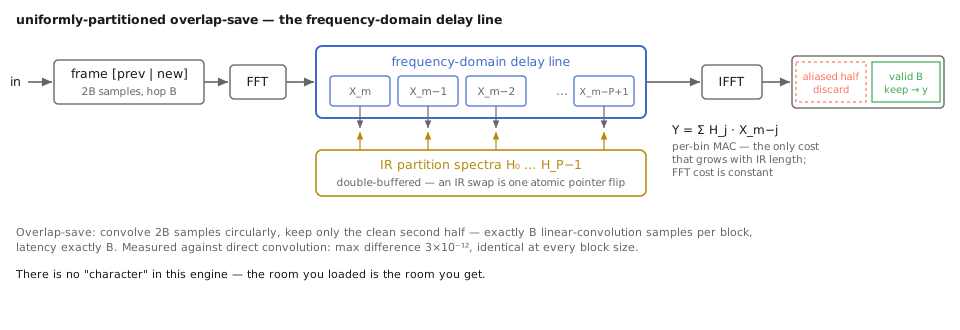
The wiring: one FFT in, one IFFT out, and a multiply-accumulate that is the only cost growing with IR length.
True stereo, by channel count
A stereo room isn't two mono rooms: sound from the left source arrives at the
right ear too. The engine runs the full 2×2 matrix — LL, LR, RL, RR — and the
buffer~'s channel count selects the topology:
- 4+ channels: true stereo, all four paths (measured: a signal sent only left emerges on the right at exactly the cross-feed path's gain, 0.600 expected, 0.600 measured, with zero leakage where paths are silent).
- 2 channels: dual mono — L and R convolved separately, no cross-feed.
- 1 channel: the same mono room on both sides.
Loading rooms while the music plays
IRs are analysed off the audio thread and published atomically into a double-buffered slot: swapping IRs mid-performance neither clicks nor drops (measured RMS across the swap instant: 21.9 before, 22.1 just after), and one block later the output is bit-identical to an engine that had the new IR from the start. Load rooms like presets; the engine doesn't flinch.
Recipes
- The honest room: a measured IR (church, plate, spring — the internet is
full of them),
@mix 25 @normalize 1, and resist the urge to EQ the IR itself before tryingpredelay— 10–30 ms of it buys clarity for free. - Not a reverb at all: an IR is any filter. A single click is a delay; a strummed guitar body is a body simulator; a vowel is a formant filter. Convolution doesn't know it's supposed to make reverb.
- True-stereo width: record or synthesize the four paths with a genuinely different LR/RL from LL/RR — the cross-feed is where "being in the room" lives.
When it is not the right tool
- You want to design the reverb — decay knobs, damping, modulation,
gated tails. A static IR can't do any of that;
tap.verb~(the algorithmic Moorer reverb, with its own oversampling and limiter) can. - Zero-latency insert on a live path. The engine costs
blocksizesamples, full stop. At 64 that's 1.3 ms — small, not zero. - Time-varying convolution. Swaps are click-free but discrete; the engine doesn't interpolate between rooms.
Checkpoint
Partitioned convolution is exact linear convolution — measured to 10⁻¹² —
with one honest cost, blocksize samples of latency, and one honest dial,
block size against CPU. True stereo comes from the buffer's channel count;
IR swaps are atomic and dropout-free; and everything the effect sounds like
is the impulse response you feed it. Borrow better rooms.