Watching the scene
Stereo engineers get meters, goniometers, spectrograms — a whole cockpit. Your medium so far has been sixteen channels of abstractly-aimed microphones, monitored through borrowed ears. When something is wrong ("why is the mix left-heavy? is it left-heavy?") you need instruments that answer about the scene, not about channel voltages. The package ships two, plus a set of gauges to put them on screen.
Companion patch: patchers/booklet/09-watching.maxpat.
The compass: ambitap.energyvec~
The scene's energy vector is the loudness-weighted average direction
of everything sounding — "where is the center of acoustic mass right
now?" ambitap.energyvec~ computes it continuously: the bus goes in,
three signals come out — x (front), y (left), z (up) — each in
−1…+1, smoothed over an adjustable smoothing_time.
One dominant source: the vector points at it (this is real direction-finding — the library verifies its DOA tracking against ground truth). A balanced full mix: the vector hovers near zero, and that is its quiet everyday use — a balance meter for the sphere. A mix that drifts left-heavy shows as y creeping positive long before you'd swear to it by ear. Because the outputs are signals, they're also patchable material: run y into a panner, a filter, a projector via OSC — the mix analyzing itself back into the art.
The map: ambitap.grid~
Where the compass gives one arrow, ambitap.grid~ gives the weather
map: it integrates the bus into a directional energy image — azimuth
across, elevation down, brightness = energy — the analysis behind this
figure (two noise sources, one 8 dB quieter; the white circles mark
their true positions):
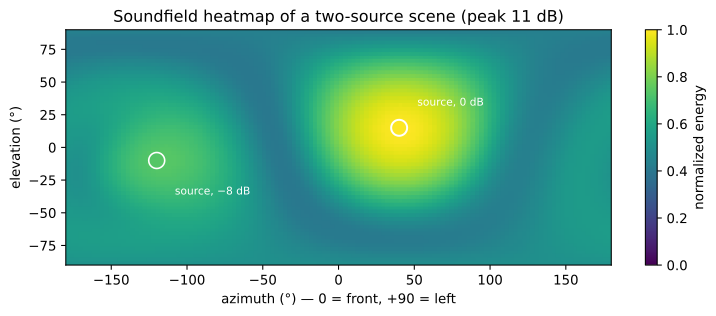
Note the honest blur: at order 3 each source paints a ~75°-wide blob (Chapter 7, now visible). You read this display for structure, not pinpoints: how many things, roughly where, how dominant, and whether energy lives where you think it does — the −8 dB source is plainly there, plainly secondary, plainly rear-right.
Mechanically the object is a passthrough plus a reporter: the bus flows
through unchanged; bang it (a qmetro 50 — display rate, not audio
rate) and it emits a grid <rows> <cols> <peak_db> <values…> list —
normalized energies ready for any display you like. Attributes:
azimuth_steps (resolution), smoothing_time (integration — long for
mix balance, short for watching movement), dynamic_range (how many dB
the brightness axis spans).
The cockpit
Lists and signals are instrument feeds; the package also ships the
gauges. Built with the externals (-DAMBITAP_MAX_BUILD_UI=ON, the
default when node is present) is a set of v8ui widgets — a
drag-to-aim panner, the heatmap (consuming exactly grid~'s
list), a DOA dot fed by energyvec~, per-speaker layout meters
for the decoder, and a rotation ball for rotate~ — with
patchers/ambitap.ui-tour.maxpat wiring all of them to a live scene at
once. The same widget set runs in a web browser as a remote control
surface over OSC (the library repo's ui/ layer). This book won't
re-document them — open the tour patch — but the companion patch embeds
the two essentials (heatmap + DOA) next to their raw-data views so you
can see the plumbing.
A monitoring practice
Instruments matter only inside a habit. A practice that fits on an index card:
- Park the compass on the master bus, always — smoothing ~1 s. Its job is the slow question: is the mix balanced on the sphere? Glance at it like you glance at a master meter.
- Raise the map when you're placing or hunting — smoothing short.
Two uses: confirm a placement went where you sent it (a
distance~typo that mutes a source is instantly visible as a missing blob), and find the actual direction of something misbehaving before reaching forvmic~(next chapter) to solo it. - Trust ears over instruments, in that order. The map shows energy, not perception: a 40°-wide blob can localize rock-solid (Chapter 7's max-rE psychoacoustics don't render on a heatmap), and the compass reads a hard-left source and a balanced chorus as the same near-zero when both coexist. Instruments answer "what is there"; only monitoring answers "how does it read."
- Meter the channels too, occasionally. Plain
mc.meter~on the bus still catches the prosaic disasters — a runaway encoder, DC, a channel-count mismatch — that scene-level instruments politely integrate away.
Checkpoint
Two instruments, two questions: energyvec~ — where is the center of
mass (balance, tracking, a patchable signal); grid~ — where is the
energy (structure, placement checks, a display feed); widgets in the
package put both on screen, and a four-line practice keeps them honest.
Now that you can see the scene, you can operate on it surgically — solo
a direction, duck a direction, flip the stage. Mixing inside the scene
is next.