Order and blur
"Which order do I need?" is the first question every newcomer asks and the question most answers dodge. This chapter answers it with numbers computed from the library, then adds the perceptual caveats that make the honest answer more interesting than the numeric one.
The exchange rate
An ambisonic scene at order N resolves direction about as finely as a beam this wide — here is the −3 dB width of the sharpest well-behaved (max-rE) beam the scene can express, against the channel count you pay for it:
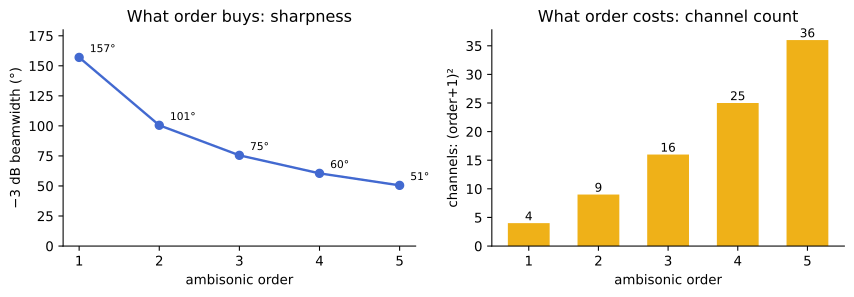
Read the two panels together and the economics of the format fall out:
- Order 1 (4 channels): a beam ~157° wide. "Leftish." Genuinely enveloping, genuinely vague. This is what a first-order microphone records and what YouTube 360 plays back.
- Order 3 (16 channels): ~75°. Sources have places, not regions. The workhorse order — sharp enough to compose with, cheap enough to run many of.
- Order 5 (36 channels): ~51°. Noticeably focused; also nine times first-order's channel count, in CPU, disk, and patch-cord width.
Sharpness improves roughly like 1/order, but cost grows like order². Each step up buys less blur reduction than the last and costs more channels than the last — that is why the answer to "which order?" is a judgment call rather than "the biggest number you can afford."
What blur actually sounds like
"Beamwidth" is a proxy. What you hear, order by order, is a bundle of effects — worth knowing individually, because different projects care about different ones:
- Source focus. At low order a point source sounds wide — pleasant for ambience and pads, wrong for a fly buzzing past an ear.
- Separation. Two sources 30° apart are one wide source at order 1, and two events at order 3+. If your material is dense and positional (dialogue scenes, counterpoint spatialization), order buys audible polyphony.
- Sweet-spot size. On loudspeakers, higher order holds the image together over a larger listening area — the low-order image collapses toward the nearest speaker sooner as you move off-center. For installations where people wander, this is often the main reason to pay for order.
- Rear/height solidity on sparse arrays. Where speakers are far apart, low order leans harder on the decoder's interpolation; images between speakers get phasey sooner.
The honest complications
The clean curve above comes with three riders that practitioners learn by expensive experience, offered here at book price.
1 — Your renderer caps what order can deliver. Binaural rendering with a non-individual HRTF (Chapter 3's mannequin ears) blurs elevation and front/back on its own; beyond roughly order 3, extra scene sharpness gets laundered through those borrowed ears and much of it is lost. On headphones with the stock KEMAR set, order 3 versus order 5 is a subtle A/B; on a good 30-speaker dome it is not subtle at all. Match spend to renderer.
2 — Microphones lag encoders. A synthetic scene can be order 5 at the cost of CPU. A recorded scene is bounded by hardware: the ambisonic microphones you can buy run from order 1 (most) through order 4 (Eigenmike em32-class instruments) — Chapter 19 surveys the market. Plan hybrid: recorded first-order bed + encoded higher-order foreground is a respectable, common design.
3 — Order interacts with frequency. The scene reconstructs the field accurately only up to a frequency that rises with order (and shrinks with listening-area radius). Above it, reproduction degrades gracefully from "physically correct" to "psychoacoustically plausible" — which is why decoders apply the max-rE weighting you met as an attribute in Chapter 5: it optimizes the plausible regime that most of the audio band actually lives in.
For the curious. The reconstruction limit is the "kr rule": accurate holography holds roughly while N ≥ kr, with k the wavenumber and r the head/area radius. For a head (r ≈ 8.75 cm) that's about 700 Hz per order — order 3 reconstructs to ~2 kHz, and everything above relies on energy-vector psychoacoustics (hence max-rE, which maximizes exactly that vector). Zotter & Frank ch. 2 (Appendix D) derives all of it. The beamwidth figure and this chapter's numbers regenerate from the library via
scripts/generate_book_figures.py, with the monotonic sharpening asserted at build time.
The planning table
Rules of thumb, not laws — each row assumes the renderer can keep up:
| Order | Ch. | Reach for it when |
|---|---|---|
| 1 | 4 | Recorded ambience beds; YouTube/360 delivery; maximum compatibility; "spacious" beats "precise" |
| 2 | 9 | Tight channel budgets (games, mobile) that still want believable movement |
| 3 | 16 | The default. Composition, installation, VR foreground, binaural work with stock HRTFs |
| 4–5 | 25–36 | Large speaker arrays and domes; wandering audiences; research; personalized-HRTF binaural |
| 6+ | 49+ | Specialist arrays and papers. AmbiTap computes to order 10; your ears in a normal room plateau far earlier |
And a rule of thumb for changing your mind: you can always truncate an ambisonic scene (drop the higher-order channels of an order-5 mix and you have a legitimate order-3, then order-1, mix — the format nests). You can never add order to a recording after the fact. When in doubt, produce one order higher than you plan to deliver.
Order chosen, channels understood — one hazard remains before the craft chapters, and it's the one that bites hardest in the wild: two files can both say "Ambisonics" and disagree about what the channels are.