Decoding to real speakers
Chapter 5 got you from bus to loudspeakers with defaults and discipline. This chapter is the craft edition: what the decoder families actually trade against each other, which to choose for which array, and what to do when your room refuses to be a diagram. It contains this book's most useful figure.
Companion patch: patchers/booklet/07-decoding.maxpat.
The problem, honestly stated
A decoder turns C scene channels into L speaker feeds — a single L×C matrix. If speakers surrounded you densely and uniformly, every sensible construction would converge on the same matrix and this chapter would be a footnote. Real arrays are sparse (four to a dozen speakers), irregular (5.1's 80° front density vs. 140° rear gap), and incomplete (no floor speakers, often no height). A matrix must now approximate, and the decoder families are three philosophies of what to sacrifice.
mode_match(the default): algebra-first. Invert the encoding process — find the feeds that would re-encode back into the original scene. Faithful where the layout supports it; where the layout is gappy, the inversion strains, and loudness can swing hard with direction.allrad: rendering-first. Decode to an ideal virtual array (mathematically perfect, exists only inside the matrix), then place each virtual speaker onto your real speakers with amplitude panning (VBAP — the object-renderer workhorse from Chapter 2, working inside your decoder). Never strains, because panning can't strain; instead it blurs where speakers are missing.epad: energy-first. A construction that keeps the decode's total energy transfer uniform (built from an orthogonalized re-encoding, discarding what the layout provably cannot render — e.g. height channels on a flat ring).
Words are cheap; here are the actual matrices measured. 5.1, order 3, max-rE on — loudness and image focus for a source swept around the circle:
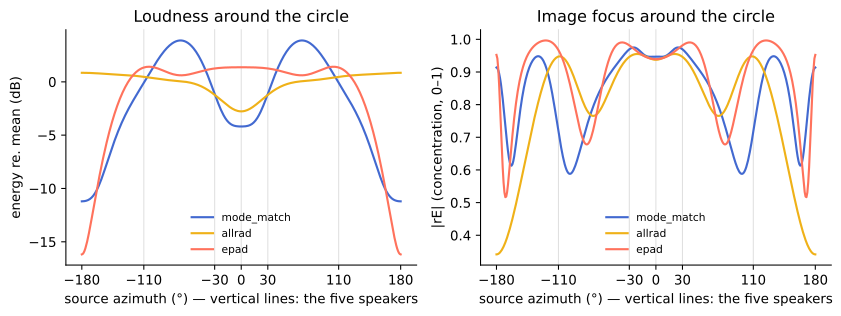
The figure is the guidance. On this gappy layout, mode_match and
epad swing 15–18 dB in loudness around the circle (listen to the left
panel: a source panned through the rear gap ducks, then blooms at the
surrounds); allrad holds loudness within ~4 dB everywhere. The right
panel shows the price: in the rear gap allrad's focus (|rE|) falls to
~0.4 — wide, wallpaper-soft imaging — where the others hold more focus
at the cost of that loudness rollercoaster. Nothing wins; the layouts
choose.
Choosing, as a table
| Your array | Reach for | Because |
|---|---|---|
| Regular ring or sphere (quad, hexagon, octagon, cube) at adequate order | mode_match (default) or epad | the inversion is healthy; you get maximum faithfulness, and the two nearly agree |
| Irregular / gappy (5.1, 7.1, 7.1.4, real venues) | allrad | even loudness beats sharp-but-lumpy on layouts with holes; this is what it was invented for (Zotter & Frank 2012) |
| Ring only, but the scene has height | epad or allrad | both handle the un-renderable height channels gracefully; naive inversion can misbehave |
| Undecided | A/B it — it's one message | decoder_type allrad etc.; rebuilds happen on a worker thread and crossfade in click-free, so switching mid-playback is a legitimate listening test |
And max_re 1, the attribute from Chapter 5, composes with all three:
it tapers the higher orders to concentrate energy (the psychoacoustic
optimum above the reconstruction limit — Chapter 7's sidebar). On real
speakers in real rooms it is almost always an improvement; the book's
default advice is simply on.
The room strikes back
The matrix assumes equidistant, level-matched, correctly-angled speakers. Chapter 5's tape-measure discipline covers the ideal case; real rooms add three adjustments worth knowing:
- Unequal distances (the sofa is against the wall): delay the near
speakers so wavefronts arrive together —
mc.delay~on the decoder's output cord, ~2.9 ms per meter of shortfall, before level matching. - Unequal speakers (the rears are smaller): match levels with pink
noise per speaker (Chapter 5), and accept that timbre will shift with
direction;
allrad's even energy makes mismatched speakers less conspicuous, one more point in its favor for found arrays. - A layout that isn't any preset: the preset list (Chapter 5's table) covers the standard rigs. For a genuinely custom array — the gallery's seven ceiling speakers — the library computes decoders for arbitrary speaker lists (it's one function call; the Max object currently exposes the presets), so a custom rig is a feature request or a small C++ patch away rather than impossible. Until then, pick the nearest preset and correct angles physically — moving a speaker beats lying to the matrix.
One loose end from Chapter 10: the nfc stage there compensates the
source's proximity. The speakers' own proximity (a desktop-radius
rig curves wavefronts too) is a further refinement — NFC-HOA per array
radius — that AmbiTap doesn't currently expose; at typical listening
radii (≥ 1.5 m) its absence is minor. Know the term, don't lose sleep.
The listening protocol
The companion patch wires the full A/B: an orbiting source, decode~ 3 surround_5_1 with the three decoder_type messages and the max_re
toggle, plus a binaural monitor branch for the speakerless. The
protocol that teaches fastest, on speakers or on the binaural stand-in:
- Orbit slowly with
mode_match. Hear the loudness swing as the source crosses the rear gap — the left panel of the figure, live. - Switch to
allradmid-orbit (it crossfades). Loudness levels out; listen for what softened in the rear. - Toggle
max_reboth ways on each. Cleaner concentration versus a hair of sparkle. - Park the source at −110° (a surround speaker) and A/B again — differences nearly vanish on a speaker; the philosophies only disagree between speakers.
Checkpoint
A decoder is one matrix and three philosophies: invert (mode_match),
re-pan (allrad), preserve energy (epad); gappy layouts favor
allrad, healthy ones favor inversion, max_re helps almost always,
and switching is a click-free message so your ears get the final vote.
Speakers handled — back to the other renderer, the one you carry in
your pocket. Binaural, properly, next.