Rooms
Every scene you've built so far takes place in deep space. Perfectly placed sources, correct distance chains — and no there there, because in real life almost nothing reaches your ears exactly once. The floor, the walls, the ceiling all answer, and that answer is most of what "sounding like a place" means. It's also, on headphones, the strongest lever on externalization: dry binaural sources love to collapse into your skull; give them a floor reflection and they step back outside.
Companion patch: patchers/booklet/06-rooms.maxpat.
What a room does, on a clock
Clap once in a rectangular room and the reply has anatomy — here rendered by the library's own room model (an 8 × 6 × 3.5 m room; every dot is one mirror-image copy of the source):
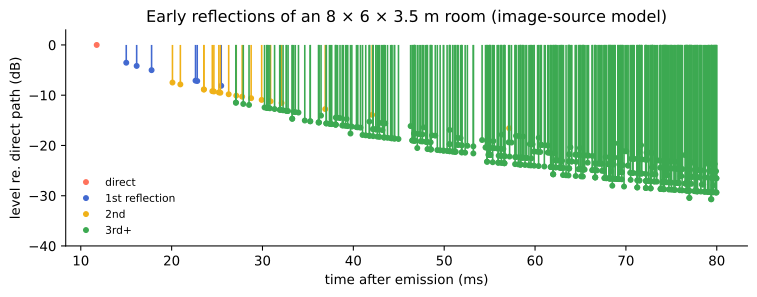
- The direct sound arrives first — alone, and the ear's localization locks onto it (the precedence effect, working for you this time).
- Early reflections follow within tens of milliseconds: first the floor and nearest walls, sparse and loud, each from a definite direction. These carry the room's size and shape — and the source's position in it.
- The tail: reflections of reflections, thickening (the figure's green wall) into a directionless wash whose decay time — RT60, the time to fall 60 dB — is the one number everyone quotes about a room.
A convincing room needs all three, with the right directions on the early part — which is exactly why doing this in ambisonics is special: the reflections are placed on the sphere like any other source, so the room turns with the scene when you rotate, and decodes to any rig.
One object, one room
ambitap.room~ is a mono-in, bus-out room simulator: direct path +
image-source early reflections + a 16-line feedback-delay-network tail,
all SH-domain, all on one HOA cord:
[click~ / your source]
    |
[ambitap.room~ 3]          ← creation arg: order (max 3)
    |
   bus …
You describe the situation, not the effect: dim_x/y/z (the room, in
meters), source_x/y/z, listener_x/y/z (positions in it), and rt60
(seconds). The object derives the reflection pattern from the geometry —
move source_x and the early reflections re-aim themselves, which no
"stereo reverb on a send" can do.
The taste controls:
direct/er/tailtoggles — the anatomy, soloable. The fastest way to learn rooms iseralone while moving the source; the fastest way to mix them istaildown when the wash swallows clarity.gain— the wet level overall.rt60band <hz> <sec>— per-band decay (bright rooms decay treble fast; state it per band rather than faking it with EQ).reflections <6 floats>— per-wall reflection coefficients (deaden the ceiling, liven the floor).absorption fir|iir— quality/CPU switch for the tail's absorption filters:fir(default) is the verified linear-phase set;iiris far cheaper and trades exact mid-band RT60. On a laptop full of rooms,iiris the honest setting.
Two costs to know about, stated plainly because the object won't hide them: the room adds a fixed ~53 ms of latency at 48 kHz (an alignment inherent to the verified design — fine for composition and installation, wrong for monitoring a live input through it), and convolution makes it one of the package's heavier objects — budget rooms like you budget reverbs, not like you budget filters.
Using it like a mixer, not a physicist
- One room, many sources is the normal architecture: sources that
share a space should share a
room~'s tail. The object is mono-in, so the practical pattern for N sources in one room is: give the featured source (or two) its own fully-positionedroom~, and let the rest share one room fed by a mono sum — ears forgive shared early reflections far more than they forgive N different rooms. - Dry/wet is
directversus the rest. The object renders the direct path too, so a source can run entirely through it; or killdirectand treat it as a pure send alongside your Chapter 9/10 chain. - Match the room to the claim. The distance chapter's cue #3 —
direct-to-reverb ratio — now works: a source far away in the room
coordinates automatically gets more room than source. Set the
geometry to agree with your
distance~settings and the illusion compounds; contradict it and ears notice something is off without knowing what. - Design visually when geometry gets fiddly: the package ships
patchers/ambitap.roomdesigner.maxpat— a floor-plan widget wired to a liveroom~, with the reflection pattern overlaid (the same image-source data as this chapter's figure).
The companion patch is the anatomy lesson: a click source in a
parametric room, the three-way toggles, and source-position controls.
Spend two minutes moving the source with only er on — hearing the
reflection pattern lean and stretch as geometry changes is the moment
rooms stop being "reverb" and become places.
For the curious. Early reflections come from the image-source method (Allen & Berkley 1979): mirror the source across each wall, recursively, and every mirror image is a straight-line arrival — the figure plots exactly that enumeration. The tail is a feedback delay network (Jot's lineage) built in the SH domain so late energy stays properly diffuse on the sphere. The library selected and verified this architecture against a measured-behavior harness (R1–R10, in the repo's docs) — including that the FDN's decay actually hits the requested RT60.
Checkpoint
Rooms are direct + early + tail; the earlies carry geometry and are the
externalization lever; room~ renders all of it onto the bus from a
physical description, rotatable and decodable like everything else. Your
scenes now have places to happen in — time to get them out of the
headphones properly. Next: decoding to real arrays, done right.