Turning your head
Chapter 1 left a debt unpaid. Time, level, and spectral cues still leave ambiguities — front/back flips, vague elevation — and real ears settle them by moving: turn your head three degrees and the way the cues change gives the answer away. Chapter 3's orbiting noise couldn't offer you that; however you turned, the scene turned with you, glued to your skull.
This chapter unglues it. Along the way you'll meet the operation that, more than any other, is why Ambisonics exists.
One new box
Open patchers/booklet/02-turning-your-head.maxpat, or splice one
object into Chapter 3's patch:
[pink~]
   |
[ambitap.encode~ 3]
   |
[ambitap.rotate~ 3]        ← NEW: rotates the entire scene
   |
[ambitap.binaural~ 3]
   |    \
[dac~ 1 2]
ambitap.rotate~ takes yaw, pitch, and roll messages — radians
again, so keep the degrees→radians expr idiom from Chapter 3 on a dial.
Park the encoder's source dead ahead (azimuth 0). Now sweep the
rotator's yaw: positive yaw swings the whole scene to your left
(counterclockwise from above, same handedness as azimuth). The source
orbits exactly as if you'd swept the encoder's azimuth — with one source,
you can't tell the difference. So add a second source, because the
difference is the entire point:
[pink~]                [cycle~ 220]
   |                      |
[ambitap.encode~ 3]    [*~ 0.2]
   |                      |
   |                   [ambitap.encode~ 3]   ← azimuth 3.14159 (behind)
   |                      |
   +----------+-----------+
              |
      [ambitap.rotate~ 3]
              |
      [ambitap.binaural~ 3]
Two encoders, their mc cables joined into the rotator's inlet — patch
cords sum, and summing scenes is mixing in ambisonics; the bus doesn't
care how many sources wrote to it. Noise ahead, a quiet tone behind. Sweep
yaw: both move together, rigidly, keeping their 180° separation — the
world turns, not a source. Pitch and roll complete the set: pitch tips
the front of the world down (positive) or up, roll tilts it around your
nose axis.
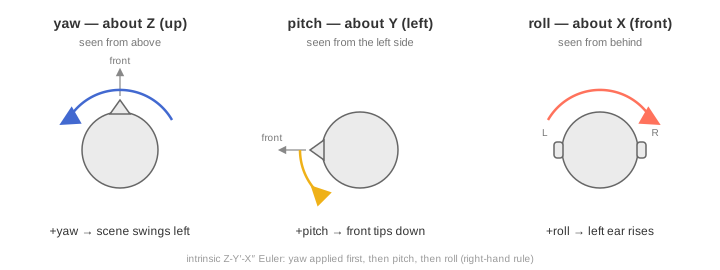
Order of operations (for the curious). The three angles compose in a fixed order — yaw first, then pitch, then roll — as intrinsic Z-Y′-X″ Euler rotations. It only matters when you use two or more at once: yaw-then-pitch and pitch-then-yaw end up in different places. If you ever port a head-tracker driver, this ordering (and the right-hand rule) is the whole game; the library pins it down in
docs/CONCEPTS.md.
Why this box justifies the format
Think about what just happened, in the terms of Chapter 2's three paradigms.
Channel-based: rotating "the mix" is meaningless — the sound is bolted to the speakers. Object-based: rotating the world means visiting every object, every frame, and re-rendering each one; the cost scales with the source count. Scene-based: the rotator never saw your sources. It saw sixteen channels, multiplied them by one 16×16 matrix, and everything in the field — two sources, or two hundred, or a recorded rainstorm with a crowd in it — turned rigidly together. Same cost, always.
That trick is not a bonus feature of the format; it is the format. The channels of an ambisonic scene are components in a directional basis chosen precisely so that rotation is a small, exact, cheap matrix. This is why, when VR needed head-tracked ambience at 60+ updates a second on a phone strapped to a face, the industry reached past its beloved object formats and standardized on Ambisonics for the job.
And it's why the box you just patched is the heart of every VR audio pipeline you've ever heard: head tracking is just yaw/pitch/roll, counter-rotated. If your head turns 30° left, rotate the scene 30° right and the mountain stays put. Any source of orientation data — a phone's gyroscope via OSC, a VR headset, a webcam head-tracker, an IMU taped to your headphones — can drive those three messages. (Sweep the dial smoothly and notice there's no zipper noise: the rotation matrix crossfades in over a few milliseconds, a courtesy you'll learn to expect from every object in the package.)
Two rotators, hiding in plain sight
Here is a subtlety that bites everyone once, so let's get bitten in a
controlled setting. ambitap.binaural~ also accepts yaw, pitch, and
roll. Same words — different meaning:
rotate~yaw turns the world. Positive: the scene swings left past your face.binaural~yaw turns your head. Positive: your virtual head turns left — so a front source now lands at your right ear.
Same axis, opposite visible effect, and both conventions are correct for
what they name. Prove they're inverses with the patch: set rotate~ yaw
and binaural~ yaw to the same value — any value — and the sources snap
back to where they started. World turns left, head turns left with it,
nothing moves relative to your ears.
In practice the division of labor is: scene rotation is composition
(turning the stage, spinning an ambience, choreography — rotate~, mixed
into the scene, heard by every listener) and head rotation is
monitoring (tracking one listener's head — binaural~'s own attributes,
applied at the very end, personal to that render). Part III returns to
this when head tracking gets real hardware attached.
Checkpoint
You can now: rotate an entire scene with one matrix, mix multiple encoded sources onto one bus by joining patch cords, tell world-rotation from head-rotation and cancel one with the other, and explain to a skeptical friend why VR audio runs on Ambisonics. Your scenes still live entirely in headphones, though. Time to put them in a room: loudspeakers next.